




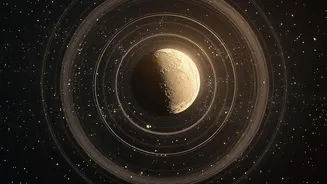
An Enduring, But Wrong, Image
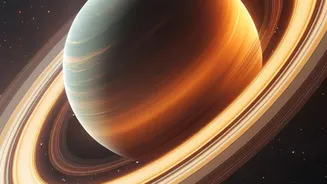
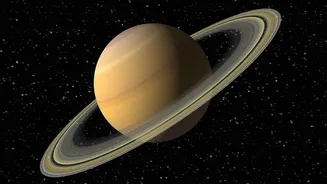
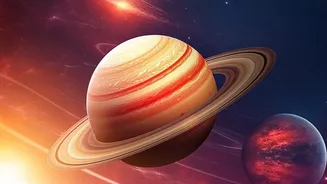
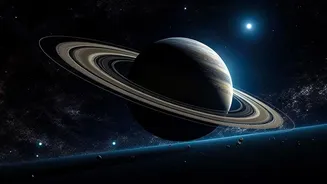
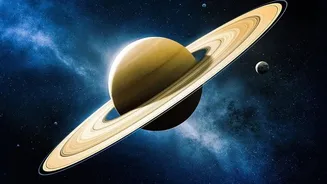
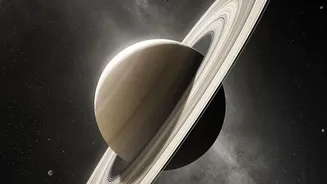
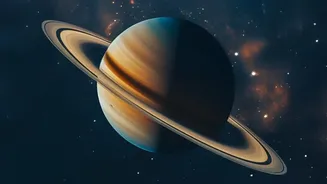
For much of scientific history, the default assumption was that Saturn's rings were as old as the planet itself, forming some 4.5 billion years ago from the same primordial cloud of gas and dust. They were seen as a grand, static monument, a placid and unchanging
feature of our cosmic neighborhood. This made sense; in the vast timescale of the cosmos, things tend to settle down. The rings’ pristine, icy brightness was a bit of a puzzle, but not enough to overthrow the prevailing theory of their ancient origins. That classic postcard view, however, has been completely upended by data that reveals a far more violent, dynamic, and recent story.
A Final Gift from Cassini
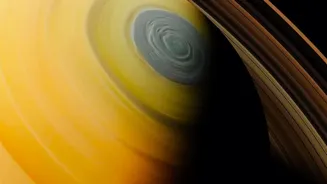
The game-changer was NASA’s Cassini spacecraft. After a magnificent 13-year tour of the Saturn system, the probe was deliberately plunged into the planet's atmosphere in 2017. In its final months, during a phase called the "Grand Finale," Cassini performed a series of daring dives into the unexplored gap between the planet and its rings. The data it collected during these final, risky orbits provided an unprecedented look at the ring system. Scientists were able to measure the mass of the rings, the rate of incoming dust, and the chemical composition of material raining down from the rings onto the planet itself. These direct measurements were crucial, allowing researchers to answer questions that had previously been limited to long-distance observation and theory.
Not So Ancient After All
One of the most startling revelations is that the rings are shockingly young. Instead of being billions of years old, evidence from Cassini suggests they are no more than 400 million years old, and possibly as young as 100 million years. This means they likely formed when dinosaurs still roamed the Earth. Scientists reached this conclusion by studying the "pollution" of the rings. The rings are made of more than 95% pure water ice, but they are constantly bombarded by a fine shower of rocky micrometeoroids. By measuring the current rate of this cosmic dust and the pristine nature of the ice, researchers calculated that it could only have been exposed for a few hundred million years at most. Any older, and the rings would be far darker and dirtier than they are.
The Case of the Missing Moon
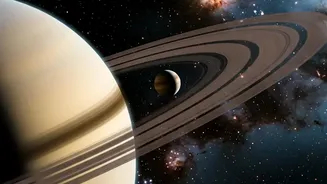
If the rings are so young, where did they come from? The leading theory points to a dramatic act of cosmic destruction. Multiple simulations suggest that Saturn once had an additional large, icy moon. This moon, sometimes nicknamed "Chrysalis," may have been destabilized by the gravitational pull of its neighbors, like Titan. Its orbit became chaotic, sending it on a collision course with Saturn itself. As Chrysalis strayed too close, it crossed a gravitational point of no return known as the Roche limit. Here, Saturn's immense tidal forces would have been strong enough to peel the moon's icy mantle from its rocky core, shattering the ice into countless fragments that then spread out to form the magnificent rings we see today. Recent models suggest this process neatly explains the rings' mass and their almost pure-ice composition.
A Fleeting Cosmic Beauty
Just as we’ve learned the rings are young, we've also learned they are not permanent. Cassini confirmed that the rings are actively disappearing, with their material raining down onto Saturn's atmosphere. This "ring rain" consists of a dusty shower of ice particles pulled inward by the planet's gravity and magnetic field. The rate of loss is staggering; scientists estimate that an amount of water equivalent to an Olympic-sized swimming pool is drained from the rings every half an hour. At this rate, the entire ring system could be gone in as little as 100 million years, a mere blink of an eye in cosmic terms. This means humanity is incredibly lucky to exist in a window of time when Saturn possesses its spectacular crown.