


A Sweet Discovery in Deep Space
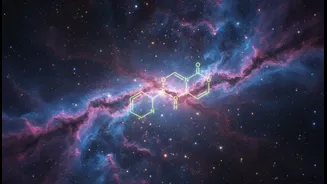
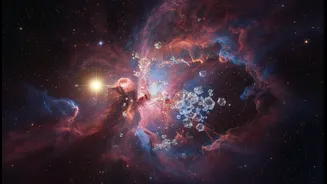
Using powerful radio telescopes in Spain, an international team of scientists has detected a sugar molecule called erythrulose floating in a vast cloud of gas and dust some 27,000 light-years from Earth. This marks the first-ever direct detection of a true
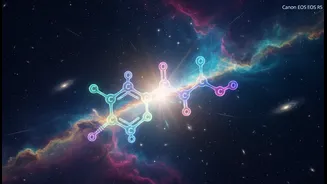
sugar in the interstellar medium—the near-empty space that exists between stars. The molecule, a four-carbon sugar also found in raspberries, was identified by its unique spectral fingerprint within a chemically rich molecular cloud known as G+0.693-0.027. While other organic molecules and even sugars like ribose have been found in meteorites that have landed on Earth, this is the first time a sugar has been spotted in the cosmic nursery where stars and planets are born.
Why This Sugar Is a Big Deal
Sugars are fundamental to life as we know it. They provide energy for cells and, most importantly, form the structural backbone of RNA and DNA, the molecules that carry genetic information. A major puzzle in understanding the origin of life is figuring out how these sugars could have formed in sufficient quantities on early Earth, as laboratory experiments simulating those conditions tend to produce only trace amounts. The discovery of erythrulose in space provides strong evidence for the theory of panspermia, which suggests that the basic ingredients for life may have formed in space and been delivered to young planets like ours by comets and asteroids. Scientists estimate millions of tonnes of erythrulose could have rained down on early Earth during a period of intense asteroid bombardment.
The Cosmic Recipe for Prebiotic Molecules
This finding does more than just add an ingredient to the cosmic pantry; it changes our understanding of the recipe. Previously, scientists believed complex molecules formed in space by gradually adding one carbon atom at a time. However, the team found that erythrulose was at least eight times more abundant than simpler, three-carbon sugars, which were not detected at all. This surprising result suggests that erythrulose forms differently, likely on the icy surfaces of cosmic dust grains, where two simpler two-carbon molecules combine. This process, happening in the extreme cold of deep space, shows that the universe is a more efficient chemical factory than previously imagined, capable of building relatively complex, life-relevant molecules even before planets exist.
Finding Bricks Is Not Finding a House
This is where the headline's crucial warning comes in. Finding erythrulose is like finding a pile of bricks; it is not the same as finding a fully built house. Astrobiologists make a clear distinction between prebiotic chemistry (the non-living processes that create life's building blocks) and biology itself. The presence of erythrulose shows that the universe is filled with the raw materials for life, making it statistically more likely that life could arise elsewhere. However, the leap from a simple sugar molecule to a self-replicating, metabolizing organism is astronomically large. These interstellar clouds also contain less-friendly compounds like cyanide. So, while the discovery is a monumental step in astrobiology, it is a clue about life's origins, not a detection of life itself.
What This Means for the Search for Life
The discovery of erythrulose is profoundly exciting because it serves as a stepping stone. In water, erythrulose can be converted into other sugars, including threose, which is thought to be a component of a possible evolutionary predecessor to RNA. This opens the door for scientists to search for even more complex and biologically crucial sugars in space, like ribose, the five-carbon sugar that is the backbone of RNA. Each discovery of a prebiotic molecule in the interstellar medium strengthens the case that the ingredients for life are not unique to Earth but are instead a common feature of the cosmos. This helps scientists refine where and how they look for signs of life beyond our planet.