





Beyond Pretty Pictures: Webb’s Infrared Advantage
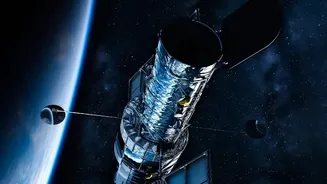
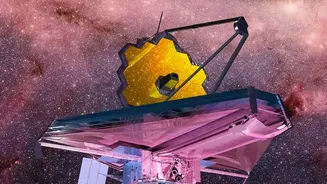
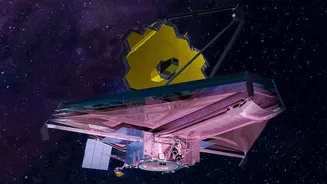
While we love the stunning images of galaxies and nebulae, the James Webb Space Telescope's true superpower in the hunt for habitable worlds lies in its ability to see in infrared light. This is crucial for studying exoplanets. When a planet passes in front
of its star, a tiny fraction of starlight filters through its atmosphere. Different gases in that atmosphere absorb specific wavelengths of light, leaving a unique chemical fingerprint in the spectrum that reaches the telescope. JWST’s sensitive instruments, like the Near-Infrared Spectrometer (NIRSpec) and Mid-Infrared Instrument (MIRI), are designed to capture this light and spread it out like a rainbow, allowing scientists to identify molecules like water vapor, methane, and carbon dioxide — key ingredients for life as we know it. This technique, called transmission spectroscopy, is our best tool for figuring out if a distant rocky planet has any air at all, and what it's made of.
Case Study: A Tale of Two Planets
Recent findings show just how complex this work is. Take 55 Cancri e, a super-hot “super-Earth” 41 light-years away. It orbits so close to its star that its surface is likely a molten magma ocean. Yet, JWST found the best evidence to date for an atmosphere around a rocky exoplanet there, detecting what could be a secondary atmosphere rich in carbon dioxide or carbon monoxide, constantly being replenished by gases bubbling out of the magma. This was a surprise, suggesting that even intensely irradiated planets can hold onto some form of atmosphere. On the other hand, the famous TRAPPIST-1 system, which has multiple Earth-sized planets in the habitable zone, has yielded more cautious results. For the innermost planets, Webb has so far found them to be bare rock with little to no atmosphere. For TRAPPIST-1e, a promising candidate, the data is ambiguous; it could have a nitrogen-rich atmosphere, or it could be bare rock, with stellar activity interfering with the measurements.
The Search for Chemical Clues
The ultimate goal is to find biosignatures — gases that hint at the presence of life. On Earth, the combination of oxygen, methane, and water vapor in our atmosphere is a strong indicator of biological processes. Finding a similar mix on a distant world would be a monumental discovery. JWST is capable of detecting these molecules. For example, observations of the candidate “Hycean” (hot, ocean-covered) world K2-18 b revealed methane and carbon dioxide, and tantalizingly, the possible presence of dimethyl sulfide (DMS) — a compound that on Earth is primarily produced by marine life. However, scientists are extremely cautious. A single gas is not proof. As seen with the exoplanet GJ 486 b, an initial signal that looked like water vapor was later suspected to be an artifact caused by cool spots on the host star's surface. This highlights a major challenge: distinguishing a planet’s atmospheric signal from the noise and features of its own star.
Habitable vs. Inhabited: A Crucial Distinction
It's important to manage expectations. When astronomers talk about a “habitable zone,” they simply mean the orbital distance where a planet could have the right temperature for liquid water to exist on its surface — if it has an atmosphere. It doesn’t mean the planet is actually habitable, let alone inhabited. The data from JWST is teaching us that many rocky planets, even in this zone, may have had their atmospheres stripped away by their host stars, especially volatile red dwarfs. The first wave of JWST results shows that definitive detection of atmospheres on Earth-sized worlds is incredibly difficult. Many observations have ruled out thick, hydrogen-rich atmospheres but haven’t been able to confirm or deny thinner, more Earth-like ones. The absence of a strong signal can be just as informative as the presence of one, telling us about a planet's violent history and the limits of habitability.