





A New League of Exploration
Chandrayaan-4 represents a monumental leap in complexity for India's space program. While Chandrayaan-3 was about successfully landing and operating on the Moon, this new mission is designed to perform a round trip: land, collect samples, and bring them
back home. If successful, India will join an exclusive club of nations — including the United States, Russia, and China — that have accomplished this feat. The mission is not just a technological demonstration; it's a critical step toward understanding our celestial neighbour in unprecedented detail. The ability to analyse lunar soil with state-of-the-art equipment on Earth promises to unlock new scientific discoveries that are not possible with remote-controlled rovers alone.
The Five-Module Mission
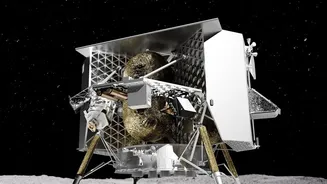
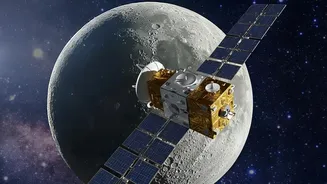
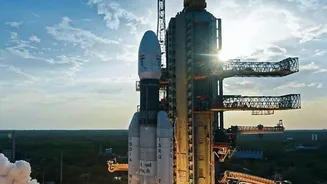
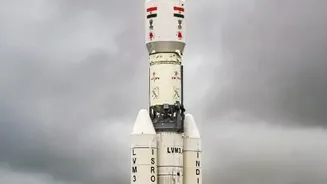
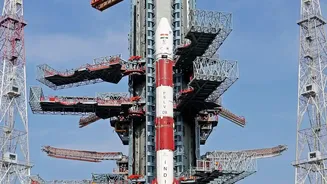
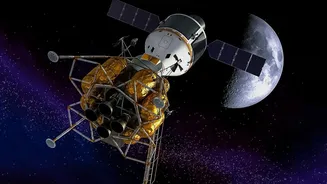
At the heart of Chandrayaan-4's complexity is its design, which involves five separate modules that must work in perfect harmony. These include the Propulsion Module, Descender Module (the lander), Ascender Module, Transfer Module, and a Re-entry Module. Due to the significant weight, the mission will require two separate launches using India’s heaviest rocket, the LVM3. The two stacks of modules will then need to meet and dock in Earth's orbit, a critical manoeuvre that ISRO has been practising with its SPADEX (Space Docking Experiment) mission. This two-launch, five-module strategy underscores the mission's scale, far surpassing the two-module architecture of Chandrayaan-3.
A Step-by-Step Guide to a Lunar Souvenir
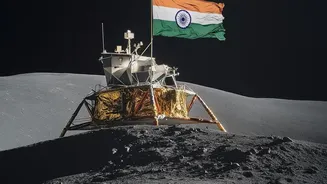
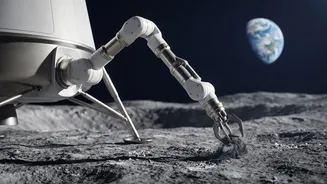
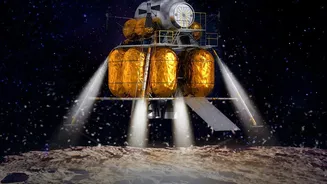
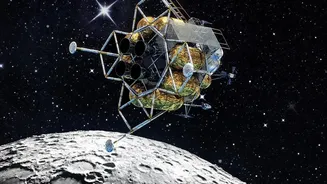
The mission plan is an intricate dance of precision engineering. After assembling in Earth's orbit, the integrated spacecraft will journey to the Moon. Once in lunar orbit, the Descender and Ascender modules will separate and begin their powered descent to a pre-selected site near the lunar south pole. After a soft landing, a robotic arm on the lander will get to work, scooping up surface soil and drilling for sub-surface samples, collecting up to 2-3 kg of lunar material. These precious samples will be sealed in a container on the Ascender module. This module will then perform another first for India: launching off the Moon's surface to rendezvous and dock with the waiting Transfer and Re-entry modules in lunar orbit. The samples will be transferred to the Re-entry Module, which will then detach and begin the final, fiery journey back through Earth's atmosphere for recovery.
Why Bring Back Moon Rocks?
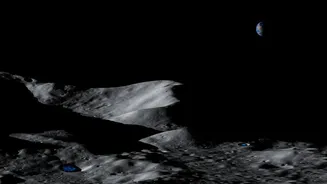
Bringing samples back is considered the gold standard of planetary science. The samples returned by the Apollo missions over 50 years ago are still yielding new scientific insights today. Analysing lunar soil in terrestrial labs allows scientists to use powerful, large-scale equipment that could never be sent to space. Chandrayaan-4 aims to retrieve samples from the lunar south pole, a region of immense global interest due to the potential presence of water ice. Studying these unique polar samples could provide crucial information about the history of water on the Moon, which is vital for planning future sustained lunar exploration and potential Moon bases. No country has yet returned samples from the lunar polar regions, making Chandrayaan-4's scientific potential globally significant.
Timeline and What Lies Ahead
The Union Cabinet approved the Chandrayaan-4 mission on September 18, 2024, with a significant budget allocation. While initial timelines were ambitious, current projections point toward a launch around 2028. This mission is not an isolated project; it's a key stepping stone in India's broader space exploration ambitions. The technologies developed and proven for Chandrayaan-4 — especially in-orbit docking, lunar ascent, and re-entry — are fundamental for future crewed missions. It directly feeds into the national goal of landing an Indian astronaut on the Moon by 2040. Success would solidify India's position as a leading space power, capable of undertaking highly complex interplanetary missions.