




Meet Roman: Hubble's Wide-Eyed Cousin
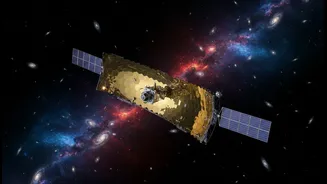
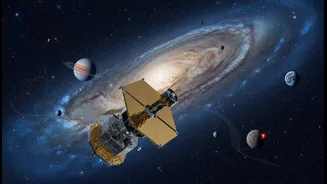
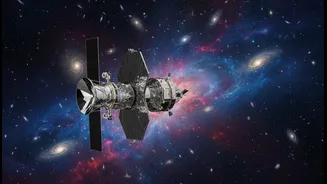
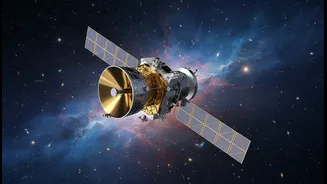
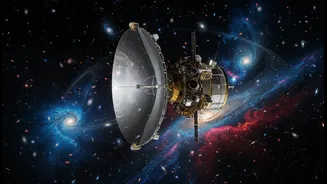
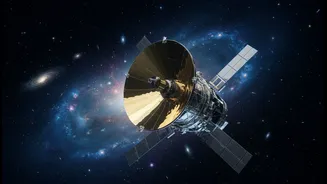
Set to launch by August 2026, the Nancy Grace Roman Space Telescope is a new kind of cosmic explorer. Named after NASA's first chief of astronomy, Nancy Grace Roman, who was instrumental in making the Hubble Space Telescope a reality, this observatory
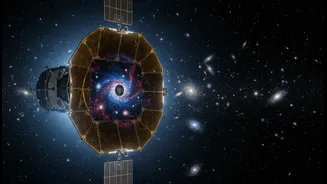
has a very different job. While Hubble and Webb excel at zooming in on specific targets for a deep, detailed look, Roman is built for breadth. It has the same size primary mirror as Hubble—2.4 meters—but its field of view is a staggering 100 to 200 times wider. This means a single snapshot from Roman can contain the detail of 100 Hubble images, allowing it to map vast regions of the sky with unprecedented speed and efficiency. Think of it as the difference between studying a single tree and creating a detailed map of the entire forest.
Hunting for Shadows in the Cosmos
One of Roman’s primary targets is something we can’t see at all: dark matter. This mysterious substance makes up about 27% of the universe but doesn't interact with light. Roman will hunt for it by charting its gravitational effects on a massive scale. The telescope will conduct a huge survey, imaging hundreds of millions of distant galaxies to measure how their light is subtly distorted by the gravity of matter in front of them—a phenomenon called weak gravitational lensing. By analyzing these tiny distortions across a huge statistical sample, scientists can create a vast 3D map of the invisible dark matter scaffolding that holds the universe together, providing our best-ever look at its structure and evolution.
A Galactic Census of New Worlds
Roman is also poised to transform our understanding of exoplanets. While NASA's Kepler mission found thousands of planets using the 'transit' method (watching for dips in starlight), Roman will primarily use a different technique called gravitational microlensing. This occurs when a star with a planet passes in front of a more distant star. The gravity of the foreground star and its planet acts like a lens, briefly magnifying the light from the background star. This method is particularly effective at finding planets farther from their star, in orbits similar to those in our own solar system, as well as detecting 'rogue' planets that don’t orbit a star at all. The sheer scale of Roman’s survey is mind-boggling; it is expected to find thousands of planets via microlensing and could detect as many as 100,000 more using the transit method, effectively conducting a galactic census of alien worlds.
Mapping the Universe's Expansion
Beyond dark matter and exoplanets, Roman will tackle another of cosmology's greatest mysteries: dark energy. This is the name given to the unknown force that is causing the expansion of the universe to accelerate. By precisely measuring the positions and distances of hundreds of millions of galaxies across cosmic time, Roman will help scientists trace the history of cosmic expansion with ten times more precision than current measurements. This data will allow researchers to test Einstein's theory of gravity on the largest scales and differentiate between competing theories about what dark energy is and how it works. This enormous galaxy survey will be a treasure trove of data, providing astronomers with a panoramic, high-resolution map of the cosmos unlike anything seen before.