








The 59-Day Spin
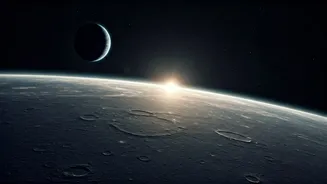
When we talk about a 'day', we usually mean one full rotation of a planet on its axis. For Earth, that's about 24 hours. For Mercury, that single spin takes a staggering 59 Earth days. This is what astronomers call a sidereal day. If you were floating
in space watching Mercury, it would take nearly two of our months for you to see the same surface feature rotate back into view. This incredibly leisurely pace is the foundation for all the planet’s temporal weirdness. For decades, scientists believed Mercury was 'tidally locked' to the Sun, meaning one side always faced it, much like how the same side of our Moon always faces Earth. But in 1965, radar observations revealed the truth was far more complex and interesting.
A Day Longer Than a Year
Here’s where things get truly mind-bending. While Mercury takes 59 Earth days to spin once, its year—the time it takes to complete one orbit around the Sun—is just 88 Earth days. Because it’s moving so quickly in its orbit while spinning so slowly, the time from one sunrise to the next is even longer. This is called a solar day, and on Mercury, it lasts about 176 Earth days. That’s right: a single Mercurian day is twice as long as a Mercurian year. You could celebrate your birthday, then wait another full Mercurian year for the sun to finally set and rise again. It’s a concept that completely flips our understanding of how days and years relate to one another.
The Sun's Gravitational Dance
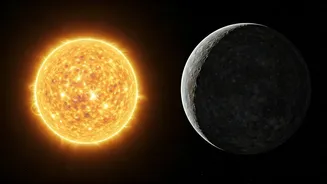
So, why is this happening? The answer lies in a special relationship with the Sun called a 3:2 spin-orbit resonance. The Sun’s immense gravity tugs on Mercury, which has a slightly elongated, egg-like shape. This gravitational pull has locked Mercury into a stable, rhythmic pattern: for every two orbits it makes around the Sun (2 x 88 = 176 days), it rotates on its axis exactly three times (3 x 59 ≈ 176 days). Think of it like a carefully choreographed dance. This resonance prevents Mercury’s rotation from slowing further into a 1:1 tidal lock, preserving this strange and unique timing. It’s a perfect, albeit bizarre, cosmic equilibrium.
A Planet of Fiery Days and Frigid Nights
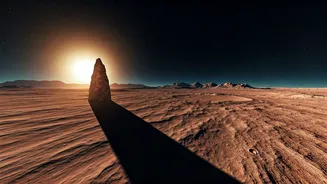
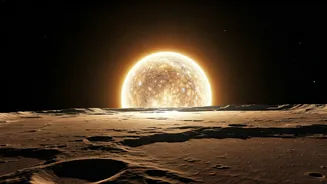
This ultra-slow rotation has dramatic consequences for the planet’s surface. With the sun lingering in the sky for months at a time, the sun-facing side of Mercury gets baked to temperatures exceeding 430° Celsius—hot enough to melt lead. There is no atmosphere to distribute this heat, so the energy just builds and builds. Conversely, during the equally long nights, with no sunlight for months, the surface temperature plummets to a bone-chilling -180° Celsius. This makes Mercury a planet of the most extreme temperatures in our solar system, swinging from hotter than an oven to colder than a deep freezer over the course of its long, strange day.