






The Challenge of Subterranean Air
Underground metro and railway stations are enclosed environments where air circulation is often limited. They act as concentration points for pollutants, particularly fine particulate matter known as PM2.5 and PM10. These microscopic particles, generated
from brake dust, wheel friction, and external traffic pollution that drifts in, pose significant health risks. Commuters and transit workers are exposed to these elevated levels daily. While mechanical ventilation systems are standard, they are energy-intensive and can struggle to effectively capture the smallest and most harmful particles, creating a persistent air quality problem right in the heart of our cities' transport networks.
Nature’s Bio-Filter Solution
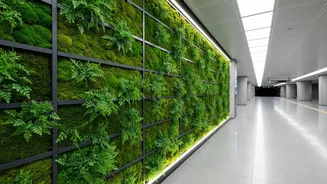
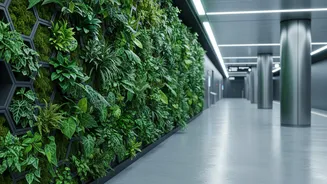
Enter the living moss wall. More than just a touch of greenery, these modules are sophisticated bio-filters. Moss is uniquely suited for this task. Unlike most plants, mosses have no root system; they absorb water and nutrients directly through their vast surface area of tiny leaves. This structure makes them incredibly efficient at trapping airborne particles. Startups and urban planners have harnessed this natural ability, creating self-contained modules that can be installed in pollution hotspots, including the confined spaces of metro platforms. These installations are essentially living, breathing air filters that work silently in the background.
How Moss Cleans the Air
The science behind moss filtration is elegant. The dense, complex structure of a moss cushion creates an enormous surface area. Due to a natural negative electrostatic charge, these surfaces attract and bind the positively charged particles of fine dust floating in the air. Once captured, the pollutants are not simply held; they are gradually broken down. Microorganisms living on the moss metabolize some of the captured particles, converting them into harmless biomass. Some modules, like the well-known 'CityTree' developed by German company Green City Solutions, enhance this natural process with Internet of Things (IoT) technology. Integrated sensors monitor air quality and humidity, automatically irrigating the moss and activating fans to pull more air through the wall when pollution levels are high, ensuring peak performance.
Proven Impact in Urban Hotspots
This isn't just a theoretical concept. Pilot projects and permanent installations in cities across Europe, including London, Paris, and Berlin, have demonstrated measurable results. Independent scientific studies have shown that moss walls can reduce fine particulate matter in their immediate vicinity by up to 30%. Companies behind the technology claim even higher figures; Green City Solutions reports their filters can remove up to 82% of fine dust from the air that passes through them. While a single moss wall won't clean an entire city's air, placing them strategically on a metro platform can create a bubble of cleaner air, significantly lowering the pollution exposure for people waiting for their train.
More Than Just Cleaner Air
The benefits of these green installations extend beyond air filtration. They bring a piece of nature into sterile, concrete environments, a concept known as biophilic design. Studies have shown that even brief interactions with nature can reduce stress, lower heart rates, and improve cognitive function. This can make the commuting experience less stressful and more pleasant. Furthermore, the moss walls have a natural cooling effect due to water evaporation, which can help regulate temperatures in stuffy underground spaces, and their porous structure provides a degree of sound absorption, dampening the clatter and noise typical of a busy station.