



The Junkyard Above Our Heads
Space isn’t as empty as it looks. Circling our planet are millions of pieces of space junk—remnants of over 60 years of space exploration. This debris ranges from entire defunct satellites and spent rocket stages to tiny fragments of metal and paint flecks.
According to NASA, there are more than 27,000 pieces larger than a softball being tracked. These objects travel at incredible speeds, up to 28,000 kilometres per hour, turning even a small screw into a ballistic threat that could cripple an active satellite or endanger crewed spacecraft. This orbital congestion poses a significant risk to the communication, navigation, and Earth observation satellites that our modern lives depend on. As the number of satellite launches increases, the urgency to clean up this high-speed junkyard has never been greater.
Magnetic Capture: A Cosmic Tow Truck
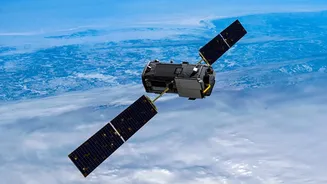
While the headline conjures images of a literal net sweeping through space, the reality is a bit more targeted and futuristic. The leading technology in this field is a magnetic capture system. One of the pioneers in this area is the Japanese company Astroscale, whose ELSA-d mission has already demonstrated the core principles of this technology. The system consists of two parts: a "servicer" satellite, which acts as the garbage truck, and a special "docking plate" that would be installed on new satellites before they launch. The servicer satellite is equipped with a powerful magnetic mechanism. When it approaches a defunct satellite fitted with the ferromagnetic docking plate, it can latch on securely without complex and risky robotic grappling. It’s less of a net and more of a powerful, precise, and reusable magnetic grappling hook designed for a cosmic game of catch.
How a Cleanup Mission Works
A typical mission involves several carefully orchestrated steps. First, the servicer satellite is launched and maneuvers itself towards its target—a dead satellite prepared with a docking plate. The servicer then performs a cosmic dance of rendezvous and proximity operations, using its sensors and cameras to inspect the target and align itself for capture. In demonstrations, Astroscale’s servicer has successfully released and recaptured its client satellite multiple times, even when the client was tumbling to simulate a real-world, out-of-control piece of debris. Once the magnetic connection is secure, the servicer acts like a space tugboat. It uses its own thrusters to push the combined stack into a lower orbit. This controlled descent ensures that both the servicer and the captured junk burn up safely upon re-entering Earth's atmosphere, leaving the orbital highway a little clearer.
The Challenge of 'Uncooperative' Debris
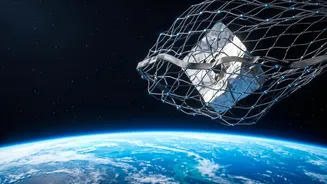
The magnetic docking plate system is an elegant solution, but it has one major limitation: it only works on future satellites designed to be compatible. The thousands of tons of debris already in orbit—from old rocket bodies to fragments from accidental collisions—were not built with a convenient magnetic handle. These are known as "uncooperative" targets. For this older junk, other technologies are being developed, including robotic arms, harpoons, and actual nets. However, magnetism may still play a role. Researchers are exploring ways to use spinning magnetic fields to create eddy currents within metallic, non-magnetic debris like aluminum. These currents essentially turn the debris into a temporary electromagnet, allowing a cleanup satellite to control its spin and gently nudge it without physical contact—a critical capability when dealing with fragile, tumbling objects.