



The Golden Rule of Sadhya Planning
The spirit of a Sadhya is abundance, a vegetarian feast where every guest leaves satisfied. While professional caterers have precise formulas, the home cook's principle is simple: it's better to have leftovers than shortages. However, smart planning prevents
excessive waste. The key is understanding that while the number of dishes can be vast—often over 20—not every person will consume a full portion of every single item. The goal is to provide enough of each component so that everyone gets to taste everything, with staples like rice and sambar being more plentiful. Before you start, get a firm headcount. This number is the foundation for all your calculations.
The Foundation: Calculating Rice
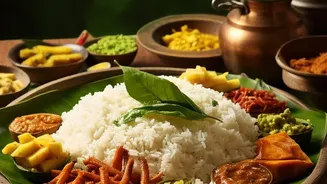
Rice is the centerpiece of the Sadhya, served in multiple rounds. Kerala's traditional Matta rice is the preferred choice. A common mistake is preparing the same amount of rice per person as you would for a regular meal. With so many accompanying dishes, guests typically eat less rice overall. A reliable guideline is to use about 3/4 of your usual measurement. For instance, if you normally cook 1/2 cup of uncooked rice per person, for a Sadhya, reduce this to a little over 1/3 cup per guest. For a party of 20, this means planning for about 7.5 cups of uncooked rice instead of 10. Another estimate used by caterers for larger crowds is approximately 28-32 kg of raw rice for 100 guests.
The Main Curries: Sambar and Parippu
Sambar, a hearty lentil and vegetable stew, is a non-negotiable part of the feast. Alongside it, a simple Parippu (dal curry) with a dollop of ghee is the first item mixed with rice. For these core liquid dishes, you need generous quantities. A good starting point for Sambar for 10-15 people is to use around 300g of toor dal (parippu). The total weight of vegetables for the sambar, like drumsticks, pumpkin, and carrots, should be around 1.5 to 1.75 kg for that same group size. For Parippu curry, about 500g of moong dal should suffice for a group of 20, as it's served in a smaller quantity than sambar.
The Vegetable Stars: Avial and Thoran
Avial, a thick mix of various vegetables in a coconut and yogurt gravy, is a standout dish. Thoran is a drier, stir-fried preparation, often with cabbage or beans and grated coconut. Because a Sadhya features several such side dishes (koottukari, erissery, olan), you don't need a full serving of each per person. A practical approach is to calculate the total amount of raw, chopped vegetables needed. For a party of 100, caterers estimate about 30-35 kg of mixed vegetables for all the side dishes combined. For a smaller home gathering of 20, aiming for a total of 5-6 kg of assorted raw vegetables for all your thorans, avial, and other sides is a safe bet. For avial specifically, using around 100g of each key vegetable (yam, carrot, beans, plantain) provides a good base for a small group.
The 'Thoducurries': Pickles and Pachadi
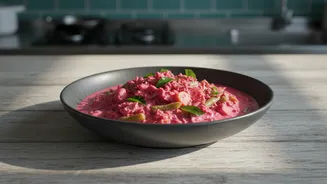
These are the accompaniments served in small quantities on the side of the banana leaf, meant to be tasted rather than eaten in large portions. This category includes pickles (mango, lime), Puli Inji (a sweet and sour ginger-tamarind chutney), and Pachadi/Kichadi (yogurt-based sides). You don't need to scale these up linearly with your guest count. A batch of Puli Inji made with 250g of ginger and tamarind will be more than enough for 20-30 guests. For pickles, a standard 300g jar is often sufficient for a large party, as each person only takes a tiny spoonful. For a Beetroot Pachadi for 10-15 people, 500g of beetroot is a good amount to start with.
The Essential Crunch: Pappadam and Chips
These items are easier to quantify. For Pappadams, plan for at least two to three per person. It's always wise to have extra, as they are a crowd favorite and some may break during frying. So for 50 guests, aim for a minimum of 150 pappadams. Banana chips (upperi) and jaggery-coated chips (sharkara varatti) are also essential. A quantity of 250g of each is typically ample for a group of 15-20 people, as they are served as initial accompaniments.
The Sweet Finale: Payasam
The dessert, Payasam, is a highlight of the meal. A standard serving size is about 100-150ml per person. When planning, a recipe that yields 1 litre of payasam will comfortably serve 7-8 people. Therefore, for 20 guests, you should aim to prepare about 2.5 to 3 litres. If serving two types of payasam, you can slightly reduce the quantity of each. For a milk-based payasam (paal payasam) serving around 7 people, a recipe might call for 100g of rice and 500ml of milk, which can then be scaled up. Remember, after a large feast, dessert portions can be smaller.