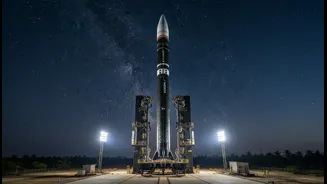










India's First Private Orbital Launch
Skyroot Aerospace is on the cusp of making history with the maiden test flight of its Vikram-1 rocket, currently scheduled for July 18, 2026. Named 'Aagaman' (Sanskrit for 'Arrival'), this mission represents India's first attempt by a private company
to launch an orbital-class rocket. While Skyroot successfully launched the suborbital Vikram-S in 2022, Vikram-1 is a far more ambitious project. It's a nearly seven-storey tall, multi-stage vehicle designed to carry satellites weighing up to 480 kg into Low Earth Orbit. A successful launch from the Satish Dhawan Space Centre in Sriharikota would be a monumental step, not just for Skyroot, but for India’s entire private space ecosystem, proving that non-government entities can build and fly complex orbital systems.
The Brains Behind the Boosters
A rocket launch generates an astronomical amount of data. Every component, from the 3D-printed engines to the carbon-composite airframe, is fitted with sensors that track temperature, pressure, vibration, and thousands of other variables in real-time. This is where data engineers become the unsung heroes of spaceflight. Their job is to build the pipelines and infrastructure to collect, process, and analyze this torrent of information. According to Skyroot CEO Pawan Kumar Chandana, this maiden flight is crucial for generating data to validate the vehicle's performance under actual operating conditions. Data engineers create the systems that turn this raw telemetry into actionable insights, helping to confirm that every stage separation is perfect, every engine burn is optimal, and the trajectory is precise. Without robust data engineering, learning from a test flight—whether it's a flawless success or a learning experience—is nearly impossible.
A Hiring Spree for a New Frontier
The intense data requirements for missions like Vikram-1 are directly fuelling recruitment. While Skyroot's current job openings span various engineering disciplines, from avionics to structural design, the need for data-savvy professionals is a clear indicator of the industry's direction. Companies like SpaceX and Rocket Lab have demonstrated that a strong data engineering backbone is essential for rapid iteration and reliability. They use data to refine designs, streamline supply chains, and automate processes. As Skyroot moves from a single test flight towards its goal of a regular launch cadence, the demand for engineers who can manage and interpret vast datasets will only grow. This recruitment drive is a sign that India's space startups are maturing from pure research and development into data-driven commercial operations.
Fueling India's Space Economy
Skyroot's expansion is part of a much larger trend. Since India opened its space sector to private participation in 2020, the industry has boomed. The number of space-tech startups has surged from a handful to over 400. India's space economy, valued at around $8.4 billion, is projected to reach as high as $44 billion by the next decade. This growth is being actively encouraged by government bodies like IN-SPACe, which facilitates private sector involvement. The success of companies like Skyroot, AgniKul, and Dhruva Space is creating a vibrant job market for skilled engineers and scientists, reducing the nation's reliance on ISRO for all space activities and fostering a new generation of innovators. This shift allows ISRO to focus on more ambitious scientific and deep-space missions, while private players cater to the burgeoning global market for small satellite launches.