


What Is a Lunar Close Approach?
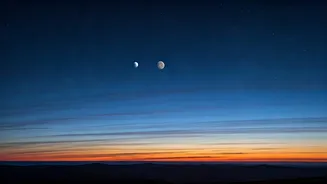
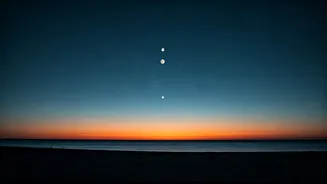
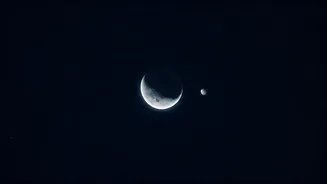
In simple terms, a lunar close approach, or conjunction, is a beautiful line-of-sight illusion. From our perspective here on Earth, two celestial objects—in this case, the Moon and the planet Saturn—appear to pass very near each other in the sky. They
aren't physically close, of course. The Moon is about 3,84,000 kilometres away, while Saturn is a staggering 1.4 billion kilometres further out in space. But their alignment in our sky creates a striking visual that has captivated stargazers for millennia. Think of it as a brief, cosmic meeting, a temporary celestial landmark that reminds us of the grand, silent dance of our solar system.
Saturn: The Moon’s Ringed Partner
The celestial partner for our Moon on this occasion is none other than Saturn, the jewel of our solar system. Famous for its magnificent and complex ring system, Saturn is the second-largest planet after Jupiter. While its rings aren't visible to the naked eye, the planet itself shines with a steady, yellowish-white light, distinguishing it from twinkling stars. Seeing it positioned so near the Moon provides a fantastic sense of scale and perspective. The Moon’s familiar, cratered glow next to the distant point of light that is Saturn makes for a humbling and awe-inspiring sight. This event offers a perfect opportunity to spot a planet that many people may have never knowingly seen before.
Why This Twilight Viewing Is Special
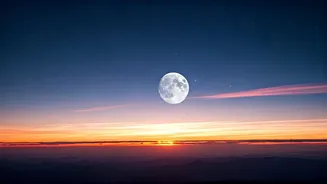
While the Moon and Saturn have these encounters periodically, the viewing conditions on June 17 are what make this event particularly noteworthy. The approach happens during the twilight hours just before sunrise. This means you won't be looking into a pitch-black sky, but one filled with the soft, changing colours of dawn. The deep blues, purples, and oranges of the twilight sky create a stunning backdrop for the celestial pairing. Furthermore, the Moon will be in its waning gibbous phase, meaning it will be bright but not so overwhelmingly full that it washes out the light from nearby Saturn. This delicate balance of light makes for a far more photogenic and visually pleasing experience than a conjunction in a darker sky.
Your Guide to Watching: When and Where
To catch this celestial show, you’ll need to be an early riser. The best time to look will be in the hours before sunrise on June 17. For most of India, this means looking towards the eastern or south-eastern sky from around 3:30 AM to 5:00 AM IST. The duo will be high enough above the horizon to be clearly visible. Your biggest challenge won't be finding them, but finding a clear view. Try to get away from tall buildings or trees that might obstruct your view of the eastern horizon. An open field, a rooftop terrace, or even a quiet beach would be ideal. The less light pollution you have, the more brilliant the view will be, but the event is bright enough to be seen even from urban areas.
Do You Need a Telescope?
Absolutely not! The beauty of this close approach is that it is a fantastic naked-eye event. You will easily be able to see the Moon and the bright 'star' next to it, which is Saturn. However, if you have a pair of binoculars, you will be rewarded. Binoculars will make Saturn appear sharper and more distinct, and you’ll get a breathtaking, detailed view of the lunar surface. If you are lucky enough to have a small telescope, you’ll be in for an even bigger treat. A basic telescope can reveal Saturn's iconic rings, turning the bright dot of light into the majestic planet we all know from pictures. It’s a great chance to dust off that old telescope in the attic.
Tips for Capturing the Moment
You don't need professional gear to photograph this event. Most modern smartphones are capable of capturing decent night sky photos. For best results, place your phone on a small tripod or lean it securely against something to keep it steady. Use your phone's 'night mode' or 'pro mode' if it has one. In pro mode, you can try increasing the exposure time slightly (e.g., 2-4 seconds) and manually setting the focus to infinity (often represented by a mountain icon). For DSLR users, a tripod is essential. Use a lens anywhere from 50mm to 200mm, a moderately high ISO (800-1600), and an aperture of f/4 or wider. An exposure of a few seconds should capture both the Moon's glow and Saturn beautifully against the twilight colours.