
What Are These 'Super-Earths'?
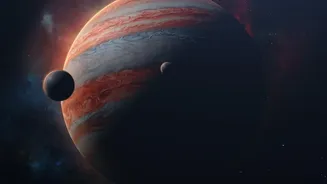
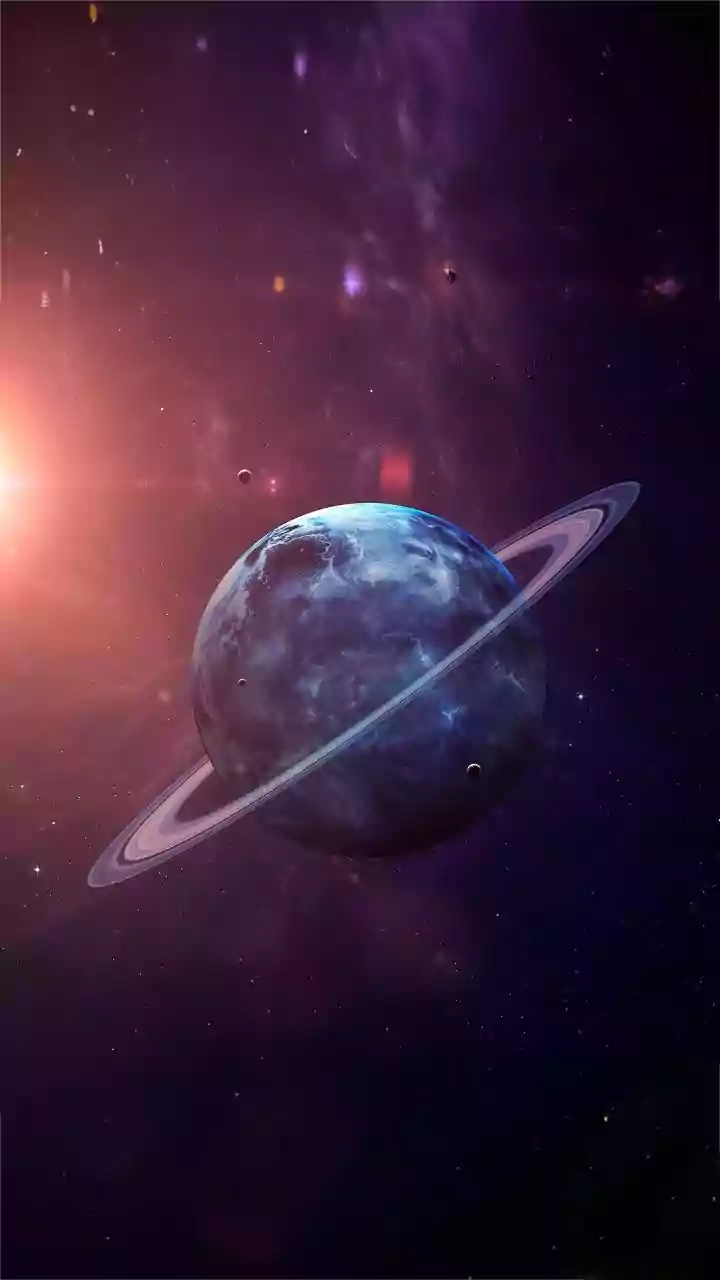
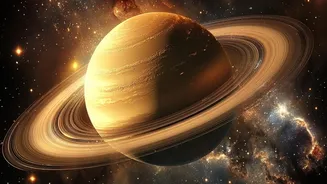
Super-Earths are a class of exoplanet unlike anything in our own solar system. They are more massive and larger than Earth but smaller than our ice giants, Neptune and Uranus. The term refers only to the planet's size and mass, not whether it is habitable.
These worlds can be rocky like Earth, gaseous like a mini-Neptune, or a combination of both. Astronomers are fascinated by them because they appear to be one of the most common types of planets in our galaxy, even though we don't have one in our own cosmic neighbourhood. This makes them a prime target in the search for worlds that could potentially harbour life.
Peering into Alien Atmospheres
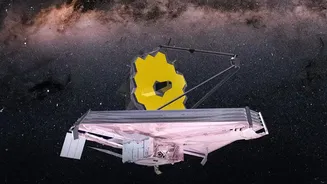
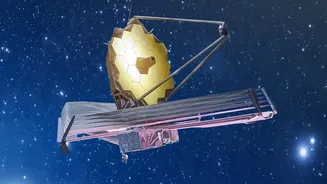
So how do you find water on a planet that is light-years away? Scientists use a technique called transit spectroscopy. When an exoplanet passes in front of its host star from our point of view, a tiny fraction of the starlight filters through the planet’s atmosphere. The powerful instruments aboard the JWST, which are highly sensitive to infrared light, can analyse this filtered light. Different molecules in the atmosphere absorb light at specific wavelengths, leaving a unique chemical fingerprint in the light spectrum. Water vapour has a very distinct signature, and by capturing it, JWST can effectively 'taste' the air of a distant world without ever going there.
The Worlds with Watery Skies
Recent observations have focused on several fascinating super-Earths. One notable example is K2-18 b, a planet about eight times the mass of Earth orbiting a star 110 light-years away. While the Hubble Space Telescope first hinted at water there, JWST's more powerful observations have not only confirmed water vapour but also detected carbon-bearing molecules like methane and carbon dioxide. Another planet, GJ 1214 b, has long been a mystery due to a thick layer of haze. JWST managed to peer through this veil, revealing a reflective, steamy atmosphere, suggesting it could be a 'water world' where water is a major component of its makeup.
Does Water Vapour Equal Life?
Finding water vapour is incredibly exciting, but it's important to keep expectations in check. The presence of water in gaseous form does not automatically mean a planet has liquid oceans or is habitable. Many of the super-Earths studied so far, like 55 Cancri e, are incredibly hot, with surfaces that are likely molten oceans of lava. On these worlds, the detected water is steam at extreme temperatures. However, the fact that these scorching, rocky planets can hold onto an atmosphere at all is a major discovery in itself. It proves that the building blocks for a potentially habitable environment are common throughout the galaxy.
The Next Chapter in an Ancient Quest
These confirmations are not the end of the story but a pivotal new beginning. Each detection of an atmospheric component helps scientists refine their models of how planets form and evolve. The JWST will continue to point its golden mirror at these worlds and others, searching for a more complex cocktail of gases. The ultimate goal is to find biosignatures — combinations of gases like oxygen, methane, and carbon dioxide that are unlikely to exist together without the influence of life. These recent discoveries have validated the telescope's incredible power and proven that we have the tools to systematically search for potentially habitable worlds for the first time in human history.