






The IMF's Urgent Warning
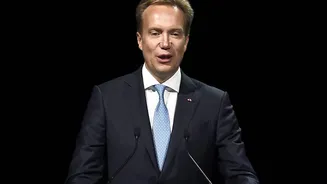
During the recent annual meetings of the IMF and World Bank, IMF Managing Director Kristalina Georgieva delivered a powerful message on Artificial Intelligence. She warned that without robust safeguards and a shared ethical framework, the risks of AI
could ultimately overshadow its enormous potential benefits. Likening the rapid pace of AI development to a Formula One car racing without safety barriers, Georgieva stressed that society has not yet established the foundational ethics to manage the technology safely. While acknowledging that AI investments are currently boosting global economic activity, she cautioned that this boom could turn to bust if the promised productivity gains don't materialize as quickly as markets expect, leading to a potentially sharp and painful market correction.
Productivity Boom or Social Disruption?
The core of the IMF's concern lies in the dual nature of AI's impact. On one hand, AI offers a tantalizing prospect of accelerated growth. The IMF itself noted that AI-related investments added an estimated half a percentage point to US GDP growth in 2025. On the other hand, this technological shift brings profound risks for labour markets and inequality. IMF research indicates that while workers with AI-related skills are earning more, middle-skilled jobs with routine tasks are highly exposed to automation, potentially being displaced or seeing wages depressed. This could exacerbate income inequality both within and between countries, as advanced economies are currently three times better prepared to adopt AI than low-income nations, according to the IMF's AI Preparedness Index. Furthermore, the IMF's Global Financial Stability Report highlighted the financial risks of an AI investment bubble, noting circular financing arrangements where a few large tech firms invest heavily in each other, creating a mirage of stability.
What Do 'Ethical Guardrails' Look Like?
So, what does the IMF mean by 'guardrails'? This isn't about halting innovation but about guiding it responsibly. Georgieva advocated for a hybrid approach that combines industry self-regulation with active government engagement. Given the rapid evolution of the technology, she noted that governments alone may struggle to keep pace. The proposed framework involves several key components: ensuring access to digital infrastructure and electricity for all nations; investing in education and reskilling to prepare the workforce for new demands; and establishing clear standards for data privacy and algorithmic transparency. The goal is to create a system where AI is trustworthy, fair, and controllable. International institutions like the IMF would play a role by providing expertise on macroeconomic impacts, while global cooperation would be essential to prevent a fragmented, race-to-the-bottom regulatory landscape.
Why This Matters for India
The IMF's message is particularly resonant for India. Kristalina Georgieva specifically named India, alongside the US and China, as a key AI-producing nation that has a responsibility to help shape these global norms. This aligns with India's own ambitions. The national strategy, guided by NITI Aayog, is built around the principle of '#AIforAll', aiming to use AI for inclusive social and economic growth. The strategy focuses on critical sectors like agriculture, healthcare, and education to solve uniquely Indian challenges, with the goal of creating scalable solutions for other developing nations. The IMF's call for building digital infrastructure, enhancing skills, and ensuring equitable access directly supports India's strategic objectives. As India seeks to establish itself as a global 'AI Garage', balancing its drive for innovation with the need for responsible governance will be crucial to harnessing AI's benefits while protecting its population from potential disruptions.