






The Invisible Contaminant in Our Meals
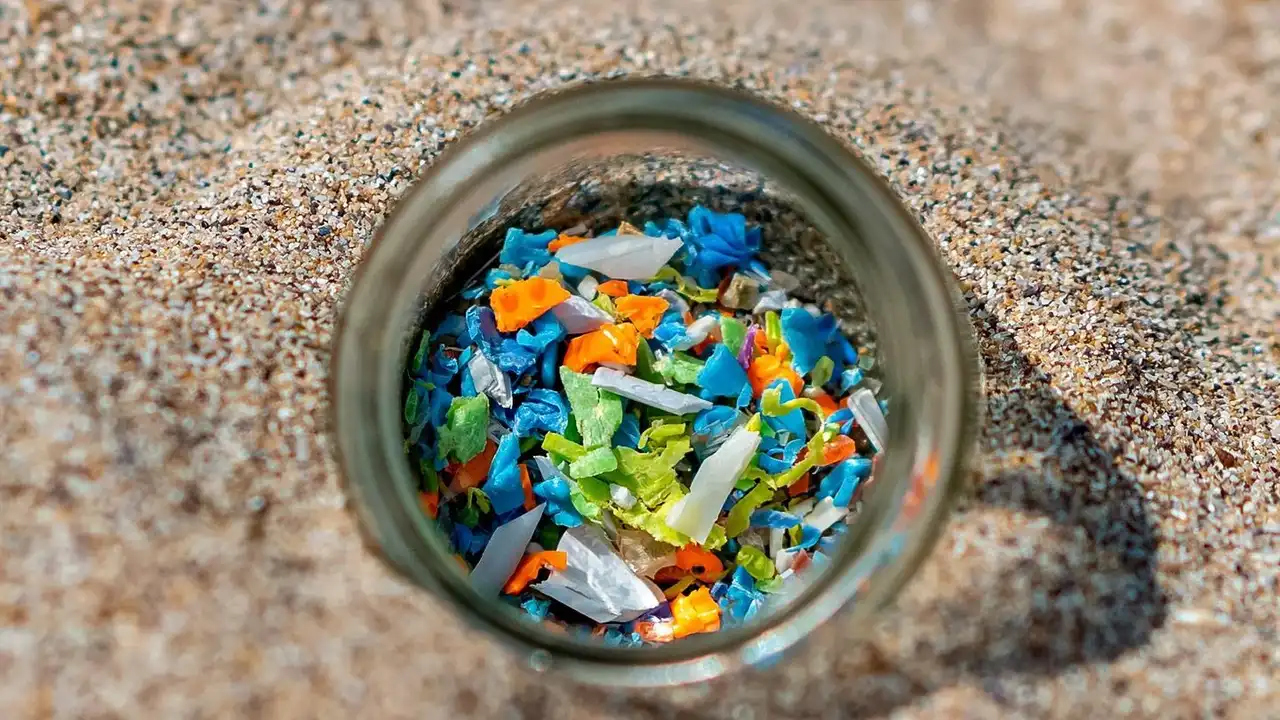
Microplastics are tiny plastic particles less than five millimetres in size. They come from the breakdown of larger plastic waste, or are intentionally manufactured as microbeads in cosmetics and industrial pellets. These particles infiltrate every corner
of our environment, from oceans to soil. As a result, they inevitably find their way into the food chain. They have been detected in a wide array of products, including seafood, salt, sugar, honey, and even bottled water. This contamination can happen at multiple stages: through environmental exposure where food is grown or raised, during industrial processing, or even through migration from plastic packaging.
Like Finding a Needle in a Haystack
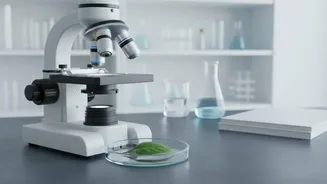
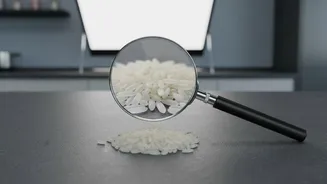
The primary reason measuring microplastics is so difficult is the complexity of food itself. Imagine trying to find a few tiny, transparent specks of plastic in a bowl of rice or a piece of fish. Food is a complex 'matrix' of fats, proteins, and other organic components that interfere with detection. To find the plastics, scientists must first digest away all this organic matter, a tedious and delicate process. Furthermore, plastics aren't a single substance. They come in countless polymer types, shapes, and sizes, from visible fragments to nanoparticles too small for many instruments to reliably detect. This variability makes it hard to develop a single, one-size-fits-all detection method.
No Universal Ruler for Measurement
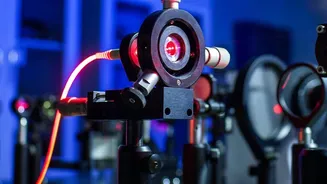
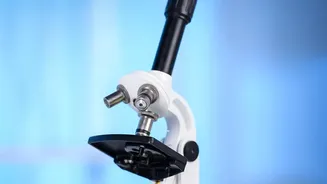
A significant barrier to understanding the true scale of contamination is the lack of standardized analytical methods. Different laboratories use various techniques, making it difficult to compare results across studies. The most common methods are forms of vibrational spectroscopy, such as Fourier-Transform Infrared (FTIR) and Raman Spectroscopy, which identify the chemical fingerprint of polymers. However, each has limitations. For instance, FTIR struggles with particles smaller than about 10-15 micrometres, while other methods are destructive, meaning the particle size can't be determined. This lack of a unified protocol means we have an inconsistent and incomplete picture of our total exposure. The U.S. Food and Drug Administration (FDA) has noted that this variability is a key barrier to assessing potential health effects.
The Contamination Conundrum
Paradoxically, the tools used to find microplastics can sometimes be a source of contamination themselves. A 2026 study revealed a startling discovery: common laboratory gloves can shed thousands of particles that are easily misidentified as microplastics like polyethylene. Because microplastics are ubiquitous, researchers must take extreme precautions, such as working in specialized clean-air chambers and avoiding all plastic lab equipment, to prevent contaminating their own samples. This risk of accidental contamination can lead to an overestimation of microplastic counts, further complicating the already difficult task of getting an accurate reading and potentially skewing data used to inform public policy.
The Looming Health Question
This measurement challenge directly impacts our ability to understand the health risks. While studies on human cells and animals suggest potential links between microplastic exposure and issues like inflammation, gut microbiome disruption, and hormonal changes, direct evidence in humans is still limited. Particles can also act like sponges, absorbing and transporting other harmful chemicals into the body. Without accurate data on how much and what types of plastics we are ingesting, it's nearly impossible for regulatory bodies to conduct a proper risk assessment or establish safety limits. Essentially, we can't regulate what we can't reliably measure.
Innovating for a Clearer Picture
Despite the hurdles, the scientific community is pushing forward. Researchers are refining extraction protocols and developing novel techniques to improve accuracy and speed. Machine learning and artificial intelligence are being harnessed to analyze complex spectroscopic data more efficiently and accurately than human analysts. One AI tool, PlasticNet, has shown the ability to classify common plastics with over 95% accuracy. Other innovations include new portable tools that use fluorescent labeling to rapidly detect even nanoplastics, offering hope for faster and more accessible monitoring in the future.