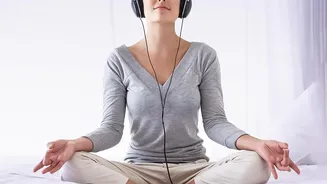






Often called 'yogic sleep', Yoga Nidra is a powerful meditation technique that guides you into a state of deep relaxation while you remain aware. The key lies in the structured audio guidance that makes this profound rest accessible to anyone.
The Foundation: Preparation and Intention
Every Yoga
Nidra session begins with settling in. A guide's voice will first prompt you to find a comfortable position, typically lying on your back in 'savasana' (corpse pose), with support from pillows or blankets to ensure the body can remain completely still without strain. The initial instructions focus on letting go of physical tension and bringing your awareness to the surrounding environment and sounds, which helps anchor you in the present moment. Once you are settled, the guide will invite you to set a 'Sankalpa' — a short, positive, present-tense resolve or intention. This is more than a simple wish; it's a seed you plant in your subconscious mind, which is particularly receptive during this state of deep relaxation. This intention becomes a powerful tool for personal transformation.
A Journey Through the Body
Following the Sankalpa, the practice moves into one of its core components: the rotation of consciousness. The guide will systematically name different parts of the body, and your only task is to move your awareness to each part as it's mentioned, without physical movement. The sequence is often rapid and follows a specific neurological map in the brain, starting with the right thumb and moving through the right side of the body, then the left side, the back, and the front. This technique helps to withdraw the senses and quiet the thinking mind. By keeping your awareness engaged in this specific, non-emotional task, you prevent it from drifting into worries or planning. It systematically relaxes the entire body and nervous system, moving you into a deeper state of conscious rest.
Awareness of Breath and Sensation
After the comprehensive body scan, the guide's focus shifts to the breath. You'll be instructed to simply observe your natural breathing without trying to control or change it in any way. You might be guided to notice the flow of air in your nostrils, the rise and fall of your abdomen, or even to count your breaths backwards from a specific number. This stage further deepens your concentration and quiets the mind. From there, the guidance often moves to an exploration of opposite sensations. The guide might ask you to feel a sense of heaviness in your body, and then a feeling of lightness, or to experience the sensation of cold and then warmth. This practice helps the mind detach from physical sensations and trains it to observe experiences without attachment or judgment, a key skill in emotional regulation.
Exploring the Mind's Eye
In the deepest phase of Yoga Nidra, the guide will introduce visualizations. This isn't about actively trying to create images, but rather allowing them to appear in your mind's eye, a space yogis call the 'chidakasha'. The guide might evoke a series of universal symbols or rapid-fire images (a soaring eagle, a tranquil lake, a burning candle) or lead you on a more narrative journey, like walking through a forest. This stage is designed to access the subconscious and unconscious mind, allowing for the release of deep-seated tensions and memories. The imagery works to balance the two hemispheres of the brain and bring forth insights from a deeper level of your being. It's a dream-like state where you are still consciously following the guide's voice.
The final stage of the audio guidance is dedicated to bringing you back to a fully wakeful state gently and gradually. The guide will first ask you to recall your Sankalpa, the intention you set at the beginning. Repeating it now, when your mind is profoundly relaxed and open, helps to reinforce its power. The guidance will then slowly shift your awareness back to your physical body and your breath. You'll be invited to notice the external world again — the floor beneath you, the sounds in the room. Finally, you'll be prompted to start making small movements, like wiggling your fingers and toes, before slowly stretching and eventually opening your eyes. This careful, structured return ensures you feel grounded, refreshed, and ready to integrate the benefits of the practice into the rest of your day.