



The Hunt for Distant Water
In the search for life as we know it, one ingredient is non-negotiable: liquid water. It’s the solvent for the chemistry of life on Earth, and it’s the top item on any astrobiologist’s checklist. Before we can dream of alien oceans, however, we must first
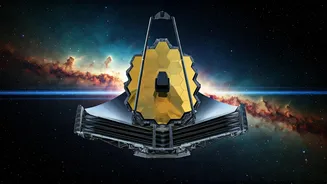
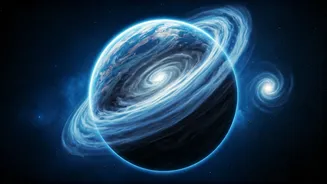
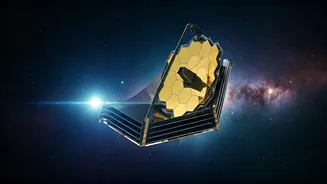
find water in any form. Thanks to incredibly powerful tools like the James Webb Space Telescope (JWST), we are now able to detect water vapor in the atmospheres of planets orbiting other stars, known as exoplanets. This is the first, critical step on the long road to identifying a potentially habitable world. Finding water vapor tells us that the basic building blocks for a water cycle are present, a breakthrough that was impossible just a few years ago.
Starlight's Secret Code
So how do scientists find a molecule like water across an unimaginable distance? They use a technique called transit spectroscopy. When an exoplanet passes in front of its host star from our perspective, a tiny fraction of the starlight filters through the planet's atmosphere. Different gases in that atmosphere absorb specific wavelengths, or colors, of light. Water vapor, methane, and carbon dioxide each leave a unique, barcode-like pattern in the starlight that reaches our telescopes. By analyzing this 'spectrum,' astronomers can identify the chemical makeup of an alien sky. The JWST is specifically designed to be incredibly sensitive to these subtle signatures in infrared light, making it the premier tool for this cosmic detective work.
From Vapor to Oceans?
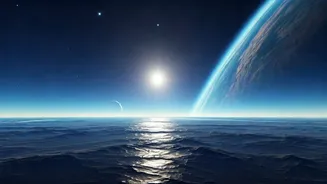
Detecting water vapor is a monumental achievement, but it doesn’t automatically mean there are oceans. A planet could have a steamy atmosphere but be far too hot for liquid water to exist on its surface, like Venus. To support liquid water, a planet needs to be in the 'habitable zone'—the 'Goldilocks' region around a star where temperatures are just right, not too hot and not too cold. Factors like atmospheric pressure and the presence of other greenhouse gases also play a crucial role. The amount of water is also key; models suggest a planet needs a significant amount to maintain a stable climate and avoid becoming an arid world. Therefore, finding vapor in the habitable zone is the combination that really excites scientists, as it's the strongest hint that surface oceans are possible.
The Intriguing Case of K2-18 b
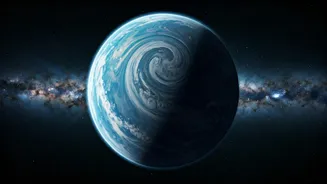
One of the most exciting targets for this research is an exoplanet called K2-18 b, located about 124 light-years away. JWST observations have confirmed the presence of carbon-bearing molecules like methane and carbon dioxide in its atmosphere, and it orbits within its star's habitable zone. This has led some scientists to classify it as a potential 'Hycean' world—a hypothetical type of planet covered by a deep ocean with a hydrogen-rich atmosphere. The possibility that such worlds could host microbial life is a tantalizing prospect for scientists. Some initial findings even hinted at the presence of dimethyl sulfide (DMS), a gas that on Earth is predominantly produced by marine life. However, this detection is highly debated, with other studies suggesting the signal could be caused by other molecules or that non-biological sources of DMS may exist. This ongoing scientific debate highlights how cautious researchers must be when interpreting these faint signals from afar.
More Than Just Water
Ultimately, finding just one molecule isn't enough to claim a planet has life. Scientists are searching for a collection of 'biosignatures'—gases that, in combination, strongly suggest biological processes. On Earth, life produces an atmosphere with both oxygen and methane, a combination that wouldn't exist for long without being constantly replenished by living things. For a Hycean world, the key biosignatures might be different, perhaps involving molecules like dimethyl sulfide, methyl chloride, or a specific imbalance of methane and carbon dioxide. The goal is to find a cocktail of atmospheric gases that is difficult to explain through geology or chemistry alone. Water vapor is the foundational clue that tells us where to look, but it's the full atmospheric picture that might one day provide an answer.