



The Reign of the Robots
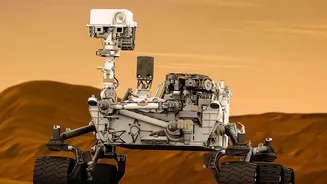
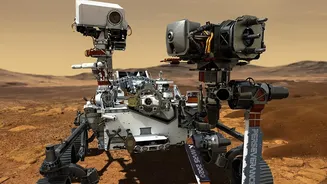
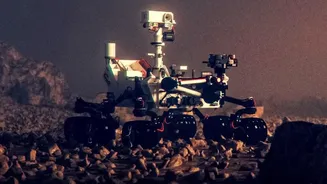
Our robotic emissaries on Mars are engineering marvels. For over a decade, the Curiosity rover has been trekking across Gale Crater, confirming that ancient Mars had the right conditions to support microbial life. More recently, the Perseverance rover,
which landed in 2021, has been hunting for direct signs of past life in Jezero Crater. It has already discovered a variety of organic molecules—the building blocks of life—and collected rock samples for a potential future return to Earth. These rovers are geological powerhouses, analyzing rock composition, studying the climate, and surviving for years beyond their initial mission timelines. Perseverance has even successfully generated oxygen from the thin Martian atmosphere, a crucial test for future human missions. These accomplishments prove that robots can conduct high-level science at a fraction of the cost and with none of the risk to human life.
The Human Advantage
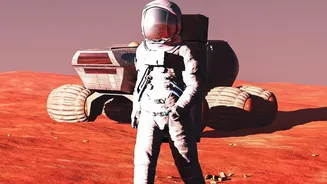
Despite the success of rovers, they have their limits. The communication delay between Earth and Mars can be up to 20 minutes, making real-time decision-making impossible. A human geologist on Mars could analyze a landscape, identify promising samples, and pivot their investigation in minutes—a process that takes a rover team on Earth days or weeks. Humans possess an intuition and adaptability that is currently impossible to program into a robot. We can navigate treacherous terrain that would trap a rover, perform complex repairs, and use a variety of tools to conduct experiments. The Apollo 17 astronauts, for example, collected a vast number of samples and covered more ground in three days on the Moon than some rovers have in years on Mars. This efficiency highlights the massive potential for scientific return when humans are on-site.
The Billion-Dollar Question
The single biggest argument for robotic missions is cost. The Perseverance rover mission cost approximately $2.75 billion. In contrast, estimates for a single crewed mission to Mars range from over $100 billion to as high as $600 billion. The enormous expense for human missions comes from the need to keep astronauts alive. This requires heavy life support systems, food, water, and perhaps most significantly, a vehicle capable of not only landing on Mars but also launching from its surface to return the crew to Earth. A robot's mission ends on Mars; for an astronaut, that's only the halfway point. For the cost of one human mission, space agencies could fund dozens of advanced robotic explorers to various destinations in the solar system.
Risk, Radiation, and Return Trips
Beyond the financial cost is the immense risk to human life. A trip to Mars would take months, exposing astronauts to the harsh environment of deep space. Two of the biggest dangers are cosmic radiation and the effects of low gravity. Unlike Earth, which is protected by its magnetic field, space is filled with high-energy particles that can damage DNA and increase the risk of cancer. Extended periods in microgravity or reduced gravity cause muscle atrophy and bone density loss. Then there are the psychological challenges of isolation and confinement, and the technical dangers of landing on another planet and launching off it again. Robots are immune to all these dangers, making them a much safer option for exploring hostile worlds.
Not a Rivalry, But a Partnership
Ultimately, the debate may not be a case of 'robots versus humans', but 'robots and humans'. The future of Mars exploration will likely involve a close partnership between human crews and their robotic assistants. NASA is already developing humanoid robots, like Valkyrie, designed to work alongside astronauts, taking on dangerous or repetitive tasks. Robots could be sent ahead to scout landing sites, deploy habitats, and set up infrastructure before the first humans even leave Earth. Once on the surface, astronauts could teleoperate rovers in real-time to explore hard-to-reach areas without the frustrating time lag from Earth. This model combines the strengths of both: the resilience and low cost of robots with the intelligence and adaptability of human explorers.