



An Unprecedented Mission
Chandrayaan-4 is not just another step; it's a giant leap. Unlike its predecessors, which studied the Moon from orbit or on its surface, this mission is designed to perform a round trip. The primary objective is to land near the lunar south pole, collect
soil and rock samples—including potential water ice—and return them safely to Earth for analysis. This makes India only the fourth country, after the United States, the Soviet Union, and China, to ever attempt such a feat. Approved by the Union Cabinet on September 18, 2024, with a budget of ₹2,104.06 crore, the mission underscores a new level of ambition for India's space program. While originally planned with a 36-month timeline, the launch is now anticipated around 2028, reflecting the sheer complexity of the undertaking.
The Lure of Lunar Ice
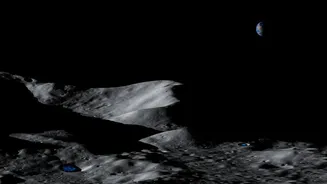
The focus on the Moon's south pole is deliberate. This region contains permanently shadowed craters where temperatures are colder than -200°C, creating 'cold traps' that are believed to have preserved water ice for billions of years. Bringing this icy regolith back to Earth is a top scientific priority. In labs on Earth, scientists can use advanced equipment far too large or delicate to send to space. Analyzing these pristine samples could unlock secrets about the origin of water in our solar system, the history of lunar volcanoes, and the delivery of materials to Earth by comets and asteroids. More practically, water ice is a critical resource for future space exploration. It can be processed into drinking water for astronauts, breathable oxygen for life support, and hydrogen for rocket fuel, potentially turning the Moon into a refuelling station for deeper space missions.
A Five-Part Spacecraft and Two Rockets
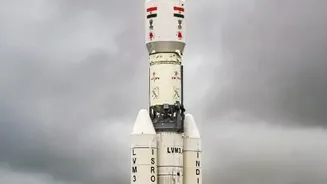
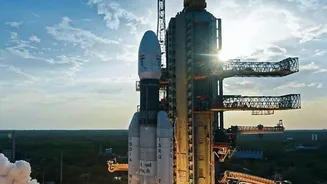
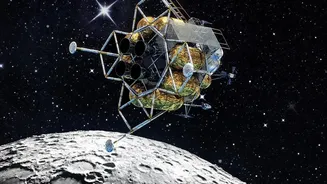
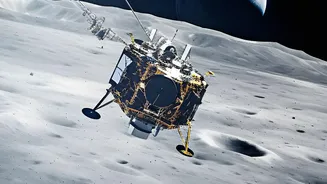
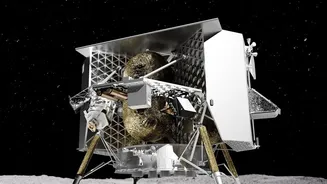
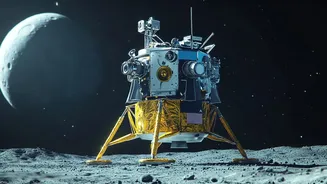
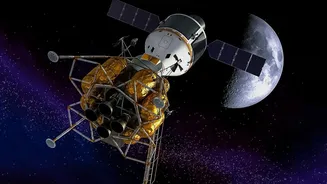
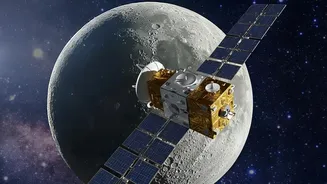
The engineering behind Chandrayaan-4 is a marvel of complexity, requiring five separate modules and two separate launches. The total mission hardware weighs around 9,200 kg, which is too heavy for even ISRO's most powerful rocket, the LVM3, to lift in a single flight. To solve this, ISRO will use two LVM3 rockets. The first launch will carry the Descender Module (the lander) and the Ascender Module. The second launch will carry the Propulsion Module, the Transfer Module, and the Re-entry Module. These two stacks will then meet and dock in Earth's orbit, a critical manoeuvre ISRO successfully demonstrated with its SPADEX mission in 2025, before heading to the Moon as a single integrated spacecraft.
The Journey to the Moon and Back
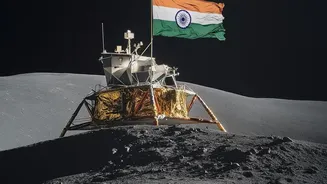
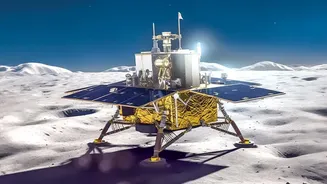
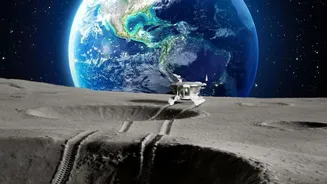
Once in lunar orbit, the Descender and Ascender modules will separate and land near the south pole. A robotic arm and a drill on the lander will collect up to 3 kg of surface and sub-surface samples, sealing them in a container. Then comes another first for India: the Ascender Module will launch from the Moon's surface, using the lander as a launchpad, to rendezvous and dock with the Transfer and Re-entry modules waiting in orbit. The precious cargo will be transferred to the Re-entry Module, which will then begin its journey home. The final, fiery stage will see the Re-entry Module perform a high-speed ballistic entry through Earth’s atmosphere before splashing down in the ocean for recovery.
Paving the Way for Future Ambitions
Chandrayaan-4 is more than a standalone scientific quest; it's a crucial stepping stone in ISRO's long-term vision. Every technology demonstrated—from robotic sample collection and orbital docking to launching from another celestial body and surviving atmospheric re-entry—is a critical capability needed for future human spaceflight. Successfully completing this mission will not only yield invaluable scientific returns but also provide the operational experience needed to achieve the national goal of sending an Indian astronaut to the Moon by 2040 and potentially establishing a lunar outpost. The mission represents a pivotal moment, transitioning India's lunar exploration from simply visiting the Moon to learning how to live and work there.