




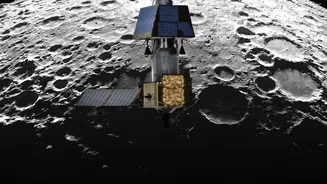
What is Chandrayaan-4?
Chandrayaan-4 is a highly complex robotic mission designed to land on the Moon, collect soil and rock samples, and return them safely to Earth for scientific study. Approved by the Indian government, the mission is tentatively scheduled for launch around
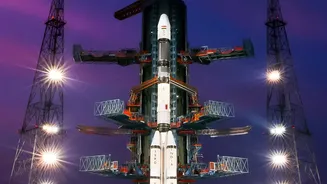
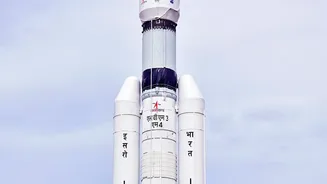
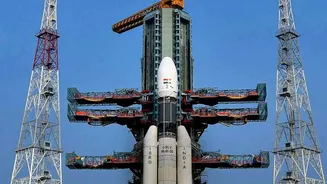
2028. Unlike its predecessors, this is not just about landing; it's about launching off the Moon and making a return journey. The mission involves five separate spacecraft modules that will work in a carefully choreographed sequence. It requires two separate, powerful rocket launches from Earth to get all the components into space, highlighting the mission's scale and complexity. Success would make India only the fourth country to achieve this feat, solidifying its position as a major player in space exploration.
The Target: Why the Moon’s Dark Craters?
The mission is targeting the Moon's south polar region, an area of immense scientific interest. This region is home to Permanently Shadowed Regions (PSRs)—craters and depressions where sunlight has not reached for billions of years. Because of the Moon's slight axial tilt, the floors of these polar craters remain in a deep freeze, with temperatures dropping as low as -250°C. These ultra-cold conditions act as 'cold traps', preserving materials that would otherwise have vanished. The most significant of these is water ice. Scientists believe these PSRs could hold vast reserves of frozen water, a crucial resource for future lunar bases, potentially providing drinking water, breathable oxygen, and even rocket fuel. Retrieving a sample from this ancient, unaltered environment could unlock secrets about the history of the Moon and the solar system.
The Scoop: A Two-Fold Collection Method
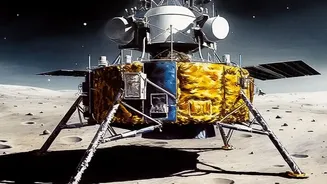
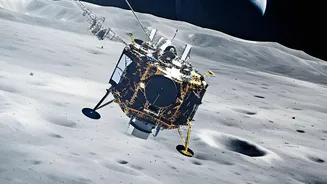
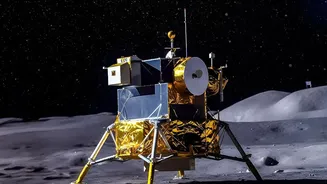
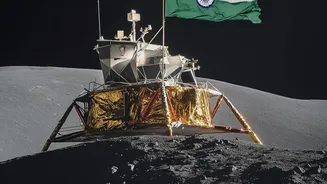
Once the Lander Module touches down near a target crater, the sample collection process begins. ISRO plans to use a sophisticated dual-method approach to gather the lunar regolith. First, a robotic arm mounted on the lander will scoop up surface soil. This will collect loose material from the topmost layer. In addition to the scoop, a drilling mechanism will be deployed to collect subsurface samples. This is crucial because it allows scientists to study material that hasn't been directly exposed to the harsh space environment. Together, these methods aim to collect up to 3 kilograms of precious lunar material. This a an entirely new technology developed in India, demonstrating the country's growing self-reliance in complex space missions.
A Complex Dance in Lunar Orbit
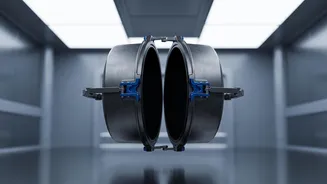
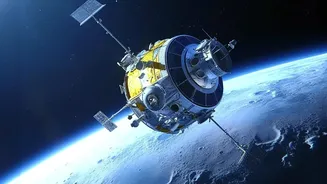
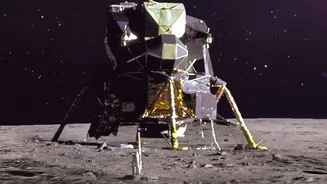
Getting the sample is only half the battle; bringing it home is where the true complexity lies. After collection, the samples will be transferred into the Ascender Module. This module will then fire its engines, lifting off from the lunar surface using the Lander Module as a launchpad. It will travel into lunar orbit to rendezvous with two other modules that have been waiting: the Transfer Module and the Re-entry Module. In a delicate, automated manoeuvre, the Ascender will dock with the Transfer Module. The collected samples will then be robotically transferred to the Re-entry Module, which is designed to protect the cargo on its final journey. This sequence of docking and transferring materials in lunar orbit is a major technological challenge, one that ISRO is preparing for with precursor experiments like SPADEX (Space Docking Experiment).
The High-Stakes Journey Home
Once the samples are secured inside the Re-entry Module, the Transfer Module will fire its engines to push the capsule out of lunar orbit and onto a path back to Earth. As it approaches our planet, the Re-entry Module will separate and begin its fiery descent through the atmosphere. This module is built to withstand the extreme heat and pressure of re-entry, protecting its invaluable contents. It will then deploy parachutes for a soft landing at a predetermined site, where scientists will be waiting to recover the pristine lunar material. Each step of this return journey, from lunar orbit to Earth landing, must be executed flawlessly.