





Peeking Through the Glare
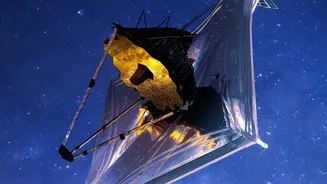
In a remarkable demonstration of its power, the James Webb Space Telescope (JWST) recently helped uncover a previously hidden planet in the well-studied Beta Pictoris system. This system, located about 63 light-years away, was already known to host two
other planets. The new world, named Beta Pictoris d, remained undetected for years because it was lost in the overwhelming light of its star and a thick, foggy disk of cosmic dust. A team using Webb didn't just rely on blocking the star's light; they used its powerful Near-Infrared Spectrograph (NIRSpec) to analyze the chemical fingerprints in the environment, detecting the tell-tale signs of a planet's atmosphere. This discovery marks a significant achievement, showcasing a novel way to find planets that traditional methods might miss.
The Firefly and the Searchlight
Directly imaging an exoplanet—a planet outside our solar system—is often compared to spotting a firefly next to a brilliant searchlight from miles away. Planets don't produce their own light; they only faintly reflect the light of their host star. This makes them incredibly dim and easily lost in the star's intense glare. A star can be billions of times brighter than its orbiting planet, making separation of the two light signals a monumental technical hurdle. To overcome this, astronomers need a way to artificially eclipse the star from the telescope's point of view. This is the core principle behind high-contrast observation, a technique Webb was specifically designed to master.
Webb’s High-Tech Visor: The Coronagraph
The key to Webb’s high-contrast capability lies in its coronagraphs. Named after the sun's corona, which becomes visible during a solar eclipse, a coronagraph is a device inside the telescope that blocks out the direct light from a star. Webb’s primary imaging instruments, the Near-Infrared Camera (NIRCam) and Mid-Infrared Instrument (MIRI), are both equipped with sophisticated coronagraphs. These aren't just simple discs; they are a series of masks, bars, and advanced phase-shifting optics that physically block starlight and manage the complex diffraction patterns it creates. This allows the incredibly faint light from a nearby planet, which would otherwise be completely washed out, to pass through and reach the telescope's sensors. It's like using a very advanced, precisely engineered sun visor to see what's hidden in the glare.
Why Infrared Vision Is Crucial
Webb’s focus on infrared light is another critical piece of the puzzle. Many of the most interesting targets, like newly formed giant planets, are still warm from their creation and emit most of their faint energy as infrared heat. Furthermore, infrared light has a longer wavelength than visible light, allowing it to pass through clouds of cosmic dust that would otherwise obscure the view. By observing in the infrared spectrum, Webb can not only see these dim, warm planets but also peer into the dusty stellar nurseries where they are born. This combination of blocking a star's light and seeing in the infrared is what makes Webb a revolutionary tool for direct imaging. It can now study exoplanets over a huge spectral range, from near- to mid-infrared, for the first time.
A New Era of Discovery
The successful use of high-contrast observation is more than just a single discovery; it represents a fundamental shift in our ability to explore other solar systems. While fewer than 100 of the thousands of confirmed exoplanets have been found through direct imaging, Webb's performance suggests that number is set to grow. This capability is vital not only for discovering new worlds but for characterizing them. By analyzing the faint light that passes through a planet's atmosphere, scientists can identify molecules like water, methane, and carbon dioxide. This opens the door to studying the chemistry of alien worlds in unprecedented detail, a key step in understanding how planetary systems form and evolve, and ultimately, in the search for habitable environments beyond Earth.