

More Than a Mealtime Staple
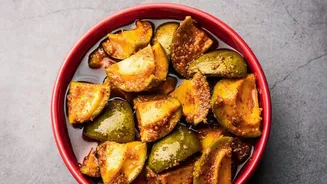
Known as 'achar,' 'uppinakaayi,' 'loncha,' and countless other names, pickles are an integral part of the Indian culinary landscape. They are a testament to an ancient tradition of preservation, dating back thousands of years as a way to make seasonal
produce last through the year. But beyond their practical purpose, pickles are an emblem of cultural heritage and familial love. The annual ritual of pickle-making, often led by the matriarchs of the family, is a communal event that brings generations together. These large batches, stored in ceramic jars called 'martabans', are not just for the immediate family but are shared with neighbours and sent in suitcases to relatives in faraway cities as a taste of home.
The Great Divide: North vs. South
The most significant variation in Indian pickles can be traced to geography. The primary difference often lies in the choice of oil, which is dictated by regional agriculture. In North India—states like Punjab, Rajasthan, and Uttar Pradesh—mustard oil is the undisputed king. Its pungent, sharp flavour and natural preservative qualities create bold, robust pickles. A classic Punjabi Aam ka Achar (mango pickle) uses mustard oil along with spices like fennel and nigella seeds. Head south, and the flavour profile shifts entirely. In states like Andhra Pradesh, Tamil Nadu, and Kerala, sesame oil (til oil) or groundnut oil is preferred, lending a nuttier, smoother base. The iconic Andhra Avakaya, also a mango pickle, is a fiery, intense preparation that relies on powdered mustard seeds and sesame oil for its distinct character. Even with the same core ingredient, the final product is a world away.
Sweet, Sour, and Everything In-Between
The diversity doesn't end with oil. In Western India, particularly Gujarat, sweet and sour profiles reign supreme. The famous 'Chhundo' is a sweet and spicy grated mango relish, traditionally slow-cooked in the sun until the sugar melts into a thick syrup. It’s a perfect balance of tangy raw mango and sweet sugar or jaggery. Travel to the East, and you'll find unique ingredients and spice blends. Bengal is famous for its 'Kasundi,' a pungent and powerful fermented mustard sauce that is far sharper than typical mustard. Bengali pickles also use the signature 'panch phoron'—a five-spice blend—and feature local produce like the Indian jujube fruit ('kuler achaar').
The Real Secret: A Grandmother's 'Andaaz'
While regional styles provide a broad framework, the true magic of variation happens at the family level. Many of these recipes have never been formally written down. They are passed from one generation to the next through observation and practice—a culinary inheritance. The 'secret ingredient' is often nothing more than a grandmother's 'andaaz' (instinctive estimation) or a mother's 'kai-gunam' (the inherent 'good hand' of the maker). One family might add a little more garlic, another might prefer less chilli, and a third might have a unique spice that no one else uses. These subtle adjustments, made over decades to suit a family's specific palate, are what make each household's achar truly one-of-a-kind. A recipe can even be born from a specific memory, like a grandfather's love for a particular pickle with his curd rice.
Climate, Crop, and Craft
The variations are also rooted in practicality. Climate plays a crucial role in preservation techniques. In the dry, arid regions of Rajasthan and Karnataka, sun-drying the ingredients before adding spices and oil is a common practice, which concentrates the flavours. In humid coastal areas, immersing the pickle completely in oil is essential to create a seal against moisture and prevent spoilage. The choice of main ingredient is, of course, tied to local availability. From bamboo shoots in the Northeast to an abundance of lemons and gooseberries (amla) in other parts, every region makes the most of what grows locally. This practical adaptation to the local environment is the very foundation upon which this rich culinary tradition is built.