





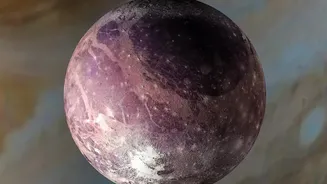

The Icy Moon with a Hidden Ocean
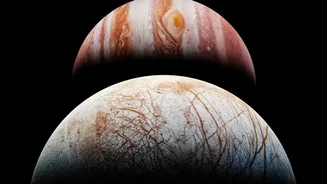
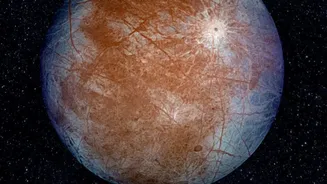
For decades, scientists have been captivated by Europa. Discovered by Galileo Galilei in 1610, this icy world is slightly smaller than Earth's moon, but it's what lies beneath its crust that sparks immense excitement. Data from previous missions strongly
suggests a global ocean of liquid water, kept from freezing by the immense gravitational pull of Jupiter, which stretches and flexes the moon, generating internal heat. Scientists believe this ocean is likely in direct contact with a rocky seafloor, creating the potential for hydrothermal vents similar to those on Earth that support rich ecosystems, independent of sunlight. These conditions—water, energy, and chemical nutrients—are the three key ingredients for life as we know it, making Europa a top target for astrobiological investigation.
Enter the Europa Clipper
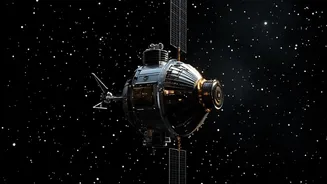
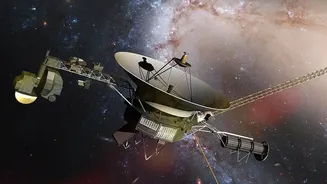
To investigate this tantalizing possibility, NASA has dispatched the Europa Clipper, a sophisticated robotic explorer specifically designed to determine if Europa has the potential for life. Launched in October 2024, the spacecraft is the largest NASA has ever developed for a planetary mission. It is undertaking a nearly six-year journey to reach the Jupiter system, using gravity assists from Mars in 2025 and Earth in 2026 to build up speed. Instead of orbiting Europa directly, which would expose it to Jupiter's dangerously high radiation levels, Clipper will orbit Jupiter and perform dozens of close flybys of the moon. This strategy allows the spacecraft to dip in for quick, intense observations—some as close as 25 kilometers from the surface—before retreating to a safer distance, extending the mission's lifespan and the quality of data it can collect.
A High-Tech Detective's Toolkit
Europa Clipper is equipped with nine powerful science instruments, all protected within a heavily shielded vault to withstand Jupiter's radiation. These tools work together to paint a comprehensive picture of the moon. An ice-penetrating radar will probe the icy shell, measuring its thickness and searching for subsurface lakes. A magnetometer will analyze Europa's magnetic field to confirm the ocean's existence and estimate its depth and salinity. High-resolution cameras will map nearly 90% of the surface in incredible detail, while spectrometers will analyze the chemical composition of the ice, looking for salts, organic compounds, and other materials that may have originated from the ocean below. A thermal imager will scan for warm spots, which could indicate recent eruptions of warmer water.
Searching for Life's Chemical Fingerprints
While Clipper is not designed to find life itself, it is engineered to detect biosignatures—chemical byproducts that could strongly suggest the presence of living organisms. Two key instruments are on the hunt for these clues: the MAss SPectrometer for Planetary EXploration (MASPEX) and the SUrface Dust Analyzer (SUDA). These instruments will directly sample particles from Europa’s faint atmosphere and any water vapor plumes that may be erupting from the surface. By analyzing the mass and composition of these particles, scientists can identify complex organic molecules, such as lipids or amino acids, and study isotopic ratios in elements like sulfur, which can be altered by biological processes. Finding certain patterns or a specific mix of these ingredients could point toward a habitable—or even inhabited—ocean.