
Unveiling the Sun’s Fiery Crown
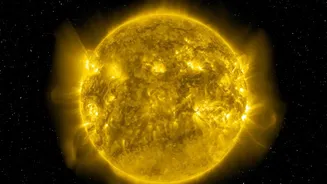
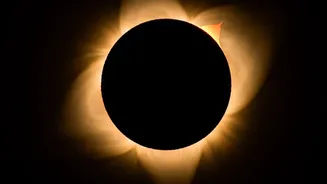
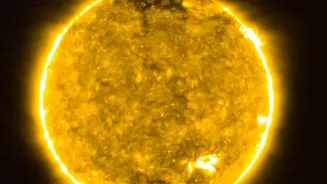
The most sought-after prize of eclipse science is a clear view of the solar corona, the Sun’s outer atmosphere. This halo of plasma is a million times dimmer than the Sun's surface, making it impossible to see in normal daylight. While instruments called
coronagraphs can create an artificial eclipse, they can't match the clarity that totality provides for viewing the innermost part of the corona. This region is crucial for understanding some of the Sun's biggest mysteries, like why the corona is hundreds of times hotter than the Sun's surface below it. Studying the corona’s intricate streamers and loops helps scientists understand the solar wind, a stream of charged particles that flows from the Sun and can impact satellites and power grids on Earth.
Putting Einstein to the Test
One of the most famous scientific achievements linked to an eclipse occurred in 1919. Sir Arthur Eddington led expeditions to Brazil and Africa to observe how starlight behaves as it passes near the Sun. According to Albert Einstein’s then-new theory of general relativity, the Sun's immense gravity should bend the fabric of spacetime, causing the light from distant stars to curve. This effect is impossible to measure normally because the Sun's brightness washes out the starlight. But during an eclipse, those stars become visible. Eddington’s teams photographed the starfield around the eclipsed Sun and compared the images to photos of the same stars taken at night months earlier. Their measurements confirmed that the starlight was indeed deflected, providing the first major experimental proof of Einstein's groundbreaking theory and making him a global celebrity.
A Sudden Change in Our Atmosphere
A total solar eclipse is essentially a massive, fast-moving experiment performed on our own planet. The sudden drop in solar radiation creates dramatic, temporary changes in Earth’s upper atmosphere, particularly the ionosphere. This layer, which stretches from about 80 to 640 kilometres above the surface, is filled with charged particles created by the Sun’s energy. It plays a critical role in radio communications, reflecting signals over long distances. When the Moon’s shadow passes, the ionosphere rapidly cools and the density of charged particles drops, mimicking the transition from day to night but on a much faster timescale. Studying these changes helps researchers better understand how the ionosphere affects GPS signals and radio communications, which can be disrupted by these atmospheric variations.
How Does Wildlife React?
It isn’t just physicists and astronomers who are interested in eclipses. Biologists also use these events to study animal behavior. Anecdotal reports have long described unusual animal reactions to the sudden midday darkness, and modern research is adding data to these observations. Studies, including one at a zoo during the 2017 American eclipse, found that about 75% of species showed some behavioral response. Many diurnal (day-active) animals began their nighttime routines, such as birds returning to their nests or gorillas heading toward their sleeping enclosures. Conversely, some nocturnal creatures may stir. Other animals, like giraffes, showed signs of anxiety. These observations provide valuable insights into how deeply rooted circadian rhythms are and how animals respond to unexpected environmental changes.