




The All-in-One Indoor Workout
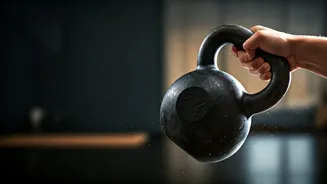
In the world of fitness, few exercises deliver the comprehensive benefits of the kettlebell swing. This dynamic, explosive movement has surged in popularity for a simple reason: it's incredibly efficient. Originating in 18th-century Russia, where they
were used as weights for strongmen and soldiers, kettlebells have become a staple in modern home gyms and fitness programmes like CrossFit. The swing itself is a ballistic hip-hinge exercise, not a squat or an arm lift. It uniquely combines strength building and cardiovascular conditioning, allowing you to get a full-body workout without needing a room full of equipment. This makes it an ideal solution for anyone seeking a high-intensity routine that fits into a busy schedule and can be performed indoors.
A True Full-Body Movement
The kettlebell swing is renowned for its ability to engage muscles throughout the entire body, with a special focus on the posterior chain—the muscles on the backside of your body. The primary movers are the powerful glutes and hamstrings, which generate the force to propel the kettlebell forward. However, the work doesn't stop there. Your core, including your abdominals and obliques, must brace intensely to stabilize your spine and transfer power. Your back muscles, including the lats, traps, and rhomboids, work to control the kettlebell and maintain good posture. Even your shoulders, forearms, and grip get a significant workout, making it a truly integrated, total-body exercise.
Unmatched Cardiovascular Benefits
While it builds strength, the kettlebell swing is also a formidable cardio tool. The continuous, explosive nature of the movement rapidly elevates your heart rate, often into the 85-95% maximum range. This makes it an excellent form of high-intensity interval training (HIIT). Studies have shown that kettlebell workouts can significantly improve aerobic capacity. Because it engages so many large muscle groups at once, your heart has to work hard to pump oxygenated blood throughout the body. This simultaneous training of both the aerobic and anaerobic systems not only improves endurance but also burns a substantial number of calories in a short amount of time, with an 'afterburn' effect that keeps your metabolism elevated even after you've finished exercising.
Mastering the Form: A Step-by-Step Guide
Proper form is crucial to maximize benefits and prevent injury. Follow these steps for a two-handed swing: 1. **Setup:** Place the kettlebell on the floor about a foot in front of you. Stand with your feet slightly wider than shoulder-width apart. 2. **The Hinge:** Push your hips back as if trying to touch a wall behind you, keeping your back flat and your chest up. Your knees should only have a slight bend. This is a hip hinge, not a squat. 3. **The Hike:** Reach down and grip the handle with both hands. 'Hike' the kettlebell back between your legs, as if snapping a football. 4. **The Swing:** In one explosive motion, drive your hips forward and squeeze your glutes forcefully. This power from your hips is what swings the kettlebell up to chest height. Your arms are just there to guide the bell; they should not be lifting it. 5. **The Float and Return:** Let the kettlebell 'float' for a moment at the top of the swing, at about chest level. As it falls, let its momentum guide it back between your legs as you hinge at the hips again to absorb the force and prepare for the next rep. 6. **Breathing:** Exhale sharply at the top of the swing and inhale as the bell comes down.
Common Mistakes to Avoid
To ensure your swing is safe and effective, watch out for these common errors: * **Squatting, Not Hinging:** A very common mistake is to bend the knees too much, turning the swing into a squat. The power should come from your hips moving backward and forward, not up and down. * **Using Your Arms:** Remember, your arms are like ropes. If you're feeling the burn primarily in your shoulders and biceps, you're likely lifting the weight instead of using hip drive. Try using a heavier kettlebell, which can force you to use your hips. * **Rounding Your Back:** Keeping a neutral, flat spine throughout the movement is essential to protect your lower back. Engage your core and keep your chest proud. * **Leaning Back at the Top:** Avoid hyperextending or leaning back at the top of the swing. Your body should form a straight, rigid plank from your head to your heels, with your abs and glutes tight.