




Escape the Glow
The first and most important step is to find a dark spot. In a country as vibrant as India, this can be a challenge due to light pollution from cities, which creates a bright glow that washes out fainter stars. For the best views, you need to get away
from the city lights. Even a short drive 30-40 kilometres away from a major urban centre can make a significant difference. Look for local parks, countryside spots, or elevated areas with an unobstructed view of the horizon. You can use online light pollution maps to find the darkest skies near your location. The darker the sky, the more celestial wonders you'll be able to see.
Your Phone is Your Planetarium
Your smartphone is the most powerful tool for a budding stargazer. There are numerous apps that turn your phone into an interactive sky map. Apps like SkyView Lite, Stellarium Mobile, and Star Walk 2 use your phone's GPS and compass to identify stars, planets, and constellations in real-time. Simply point your phone at the sky, and the app will show you exactly what you're looking at, complete with names and illustrations. Many of these apps also have features that let you see the sky in the past or future and provide rich information about the mythology behind the constellations. For users in India, the Bhagol app offers a unique experience, presenting the sky with vocabulary from Indian astronomy, including the 27 nakshatras.
Let Your Eyes Adjust
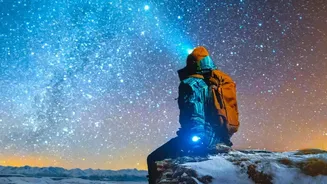
Once you've found your dark spot and have your app ready, put your phone away for a bit. Your eyes need time to adapt to the darkness to achieve their full stargazing potential. This process, known as dark adaptation, can take about 20 to 30 minutes. During this time, avoid looking at any bright lights, especially your phone screen, as a single glance can reset the process. If you need to use a light, a red torch or a phone screen with a red-light filter is best, as red light has the least impact on your night vision. Be patient; the longer you wait, the more stars will appear.
Know What to Look For
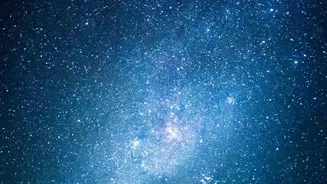
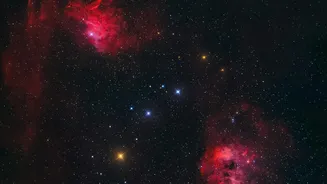
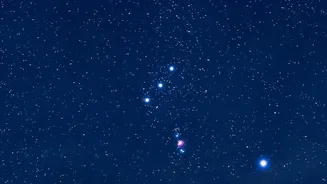
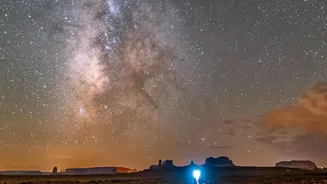
As a beginner, it's best to start with the brightest and most obvious objects. The Moon is a fantastic first target. Look for planets, which often appear as bright, steady points of light that don't twinkle as much as stars. In India, the winter months offer some of the clearest skies and brightest constellations. Look for the unmistakable shape of Orion, 'The Hunter', with its three-star belt. This constellation is a great signpost; you can use its belt to find other stars and constellations like Sirius, the brightest star in our night sky, and the Pleiades star cluster. In the summer, you might be able to spot the faint, milky band of our own galaxy, the Milky Way, stretching across the sky from a truly dark location.
Capture the Cosmos
While you won't be producing images like the Hubble telescope, your phone's camera is capable of basic astrophotography. The key is stability and long exposure. You will need a tripod or a stable surface to keep your phone perfectly still. Switch your camera to 'Pro' or 'Manual' mode. Here, you can adjust settings like ISO (sensitivity to light) and shutter speed (how long the lens stays open). Start with an ISO between 800 and 1600 and a shutter speed of 10 to 20 seconds. Use your phone's self-timer to avoid shaking the camera when you press the shutter button. Experiment with these settings to capture the stars, and use free editing apps to enhance your photos later.