





A Milestone for Crew Safety
Before India can send its ‘Gaganauts’ into orbit, the Indian Space Research Organisation (ISRO) must be absolutely certain it can bring them back safely. The Gaganyaan mission’s success hinges not just on a powerful launch, but on a flawless recovery.
This is where the parachute system comes in. It is one of the most critical safety components, a non-negotiable element designed to manage the violent final chapter of any space journey: re-entry and landing. Recently, ISRO announced another major success in qualifying this system, pushing India one step closer to launching its first crewed spaceflight. Every successful parachute test builds confidence in the mission's ability to protect its most precious cargo—its crew.
Inside the Latest Successful Test
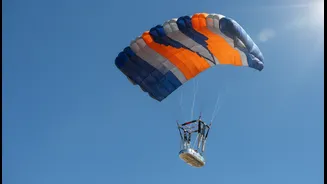
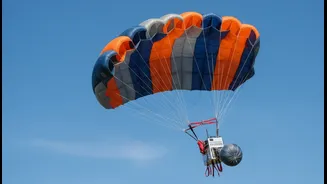
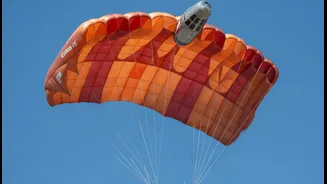
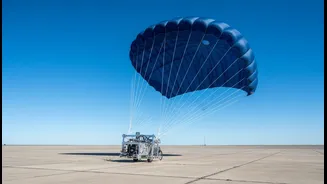
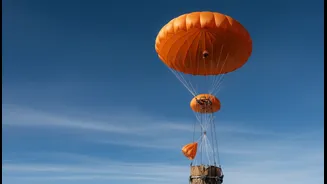
The latest achievement, part of a series known as the Integrated Main Parachute Airdrop Test (IMAT), took place over Madhya Pradesh. A dummy payload, with a mass equivalent to the Gaganyaan crew module, was lifted to an altitude of 2.5 kilometres by an Indian Air Force IL-76 aircraft and dropped. The purpose of this specific test was to push a main parachute to its limits, ensuring its structural integrity and design could handle the maximum expected loads during a real mission. The successful deployment and performance of the parachute in this high-stress scenario provides crucial data and validates the reliability of the system for the upcoming uncrewed G1 mission. This test was a collaborative effort involving ISRO, the Defence Research and Development Organisation (DRDO), the IAF, and the Indian Army.
A Symphony of Ten Parachutes
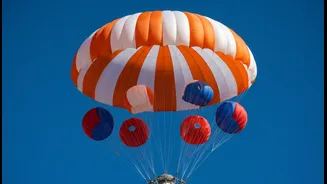
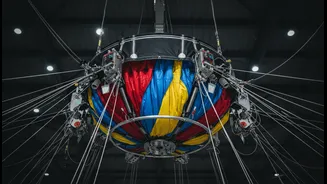
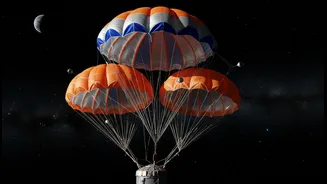
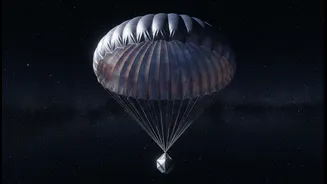
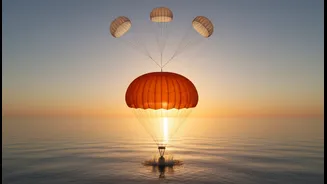
The Gaganyaan recovery system isn't just one big parachute; it's a precisely choreographed sequence involving a total of ten parachutes of four different types. The process begins as the capsule hurtles back to Earth. First, two small Apex Cover Separation parachutes deploy to jettison the protective cover that shields the main chutes from the intense heat of atmospheric re-entry. Next, two Drogue parachutes are fired out using pyro-based mortars. These conical, ribbon-style chutes are essential for stabilising the capsule and providing the first stage of significant deceleration while it is still moving at high speed. Once the capsule is stable and has slowed sufficiently, three Pilot parachutes are released. Their job is to pull the three large main parachutes from their compartments. This multi-stage approach prevents the main chutes from being torn apart by opening at too high a speed.
Engineered for Redundancy and Precision
The three main parachutes are the final and most crucial stage of the braking process. Together, they are responsible for slowing the nearly 5.3-tonne crew module from a blistering speed of over 750 kilometres per hour to a gentle splashdown velocity of less than 40 kilometres per hour. This dramatic reduction in speed ensures the astronauts experience a soft landing in the ocean. The system is built with redundancy at its core. While three main parachutes are deployed, the system is robustly designed so that even if only one fully functions, it is still sufficient to land the crew module safely. This fail-safe approach highlights the immense focus on crew safety that underpins the entire Gaganyaan programme.
From Fiery Re-entry to a Gentle Splashdown
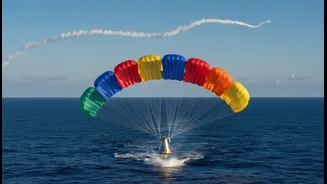
The entire recovery sequence is a masterclass in engineering precision, lasting only a few minutes. After surviving the fiery re-entry where atmospheric drag does most of the initial braking, the automated parachute deployment begins. The apex cover is blown, the drogue chutes stabilize and slow the capsule, and finally, the main canopies open to provide the final braking for a soft landing. Upon splashing down in the sea, the parachutes are jettisoned to prevent entanglement, and flotation bags inflate to keep the module upright. A sea marker dye and beacon signals are released to help recovery teams from the Indian Navy quickly locate and retrieve the capsule and its crew. Each element of this sequence must work perfectly, a result made possible only through hundreds of simulations and dozens of rigorous real-world tests like the one recently completed.