


The Sun's Turbulent Outbursts
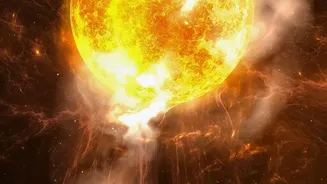
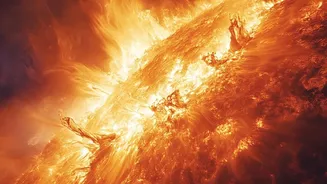
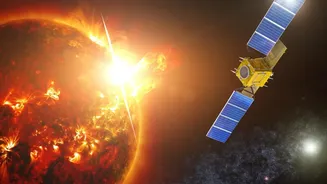
Our star is a dynamic and volatile ball of plasma. Occasionally, intense magnetic activity on its surface causes massive explosions of energy. These come in two main forms. Solar flares are intense flashes of radiation that travel at the speed of light,
reaching Earth in about eight minutes. They can disrupt radio communications almost instantly. More powerful, however, are Coronal Mass Ejections (CMEs). These are colossal eruptions that hurl billions of tonnes of plasma and magnetic fields into space. It's these CMEs, which can take one to three days to reach us, that are responsible for the most significant technological disruptions on Earth.
From Solar Storm to Earthly Impact
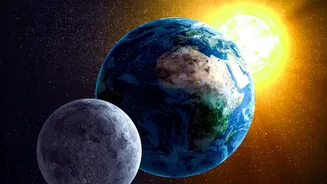
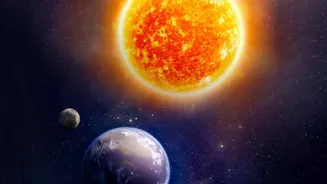
When a CME collides with Earth, it interacts with our planet's natural magnetic shield, the magnetosphere. This interaction triggers a geomagnetic storm, a major disturbance that can have profound effects on the ground. A key consequence is the creation of geomagnetically induced currents (GICs). These are powerful, uncontrolled electrical currents that flow through the Earth's surface. They seek out long metallic conductors to travel through, which makes modern infrastructure like power lines and pipelines particularly vulnerable to their effects.
Blackouts from 150 Million Kilometres Away
The most significant risk from a severe solar storm is to our electrical grids. When GICs enter high-voltage power lines, they can flow into and overload critical transformers. This can cause them to overheat and fail, leading to cascading power outages across a vast area. The most famous example of this occurred in March 1989, when a geomagnetic storm overwhelmed the Hydro-Québec power grid. The entire province of Quebec was plunged into darkness for over nine hours in less than two minutes. This event served as a major wake-up call for the energy industry about the real-world dangers of space weather.
Satellites and Navigation Under Fire
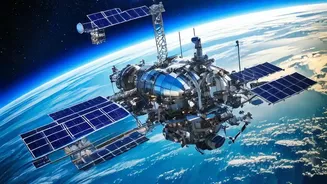
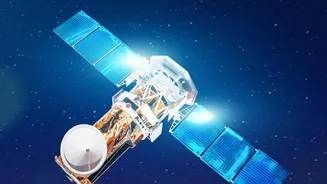
Satellites orbiting outside Earth's protective atmosphere are on the front line of any solar storm. The burst of high-energy particles can damage sensitive electronics and degrade solar panels, potentially shortening a satellite's lifespan or causing it to fail completely. Furthermore, solar storms heat and expand the Earth's upper atmosphere. This increases the atmospheric drag on satellites in low-Earth orbit, which can cause their orbits to decay. This has a direct impact on services we rely on daily, including GPS navigation, weather forecasting, and satellite television, which can suffer from errors or complete signal loss.
A Historical Warning: The Carrington Event
To understand the worst-case scenario, we can look to the Carrington Event of 1859. This was the most intense geomagnetic storm in recorded history, triggered by a massive solar flare observed by astronomer Richard Carrington. The technology of the day was the telegraph, and systems across Europe and North America failed spectacularly. Telegraph pylons threw sparks, operators received electric shocks, and some papers even caught fire. In some cases, operators could send messages after disconnecting their batteries, powered solely by the storm-induced current in the wires. A storm of this magnitude today would have a devastating impact on our electrified and connected society.