




A New View of Familiar Neighbors
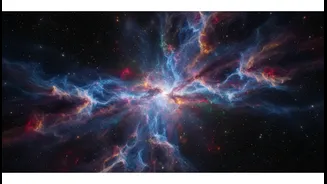
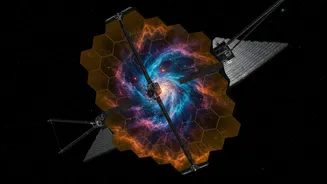
Even for celestial objects we thought we knew well, Webb is providing a stunning new perspective. To celebrate its fourth anniversary in July 2026, NASA released new images of Centaurus A, a galaxy located a relatively close 11 million light-years away.
Its strange shape is the result of a galactic collision billions of years ago. While previous telescopes like Hubble were obscured by thick lanes of cosmic dust, Webb's powerful infrared vision cuts through the haze. The new images reveal a dense tapestry of individual stars and show the complex interplay between the galaxy's supermassive black hole and surrounding star formation, helping scientists understand how a black hole can both trigger and suppress the birth of stars.
Rewriting the First Chapters of the Universe
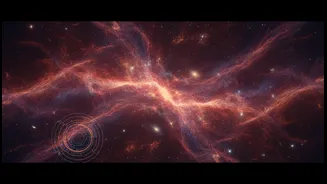
One of Webb’s primary missions is to peer back to the cosmic dawn, and it’s finding that the early universe was far more chaotic and developed than previously thought. Astronomers have found galaxies that are far bigger, brighter, and more complex than models predicted for that era. In early 2026, researchers announced the discovery of a collision of at least five galaxies that occurred just 800 million years after the Big Bang—a complex merger happening much earlier than expected. The telescope is also revealing a diversity among these early galaxies that has surprised scientists, forcing a reassessment of how the first stars and galaxies formed. These discoveries, including the identification of the earliest supernova ever found and black holes that seem to predate their host galaxies, are forcing a rewrite of the first chapters of cosmic history.
A Glimpse of Our Solar System's Future
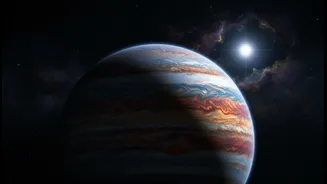
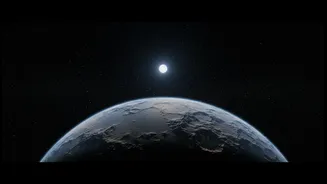
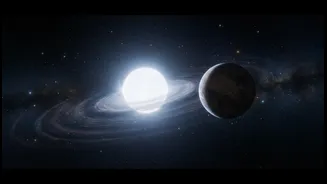
Webb isn't just looking at the distant past; it's also providing a potential glimpse into our solar system's distant future. In a remarkable discovery announced in July 2026, astronomers used Webb to study WD 1856 b, a Jupiter-sized planet orbiting a white dwarf—the tiny, dense core left behind after a star like our Sun dies. The planet orbits 50 times closer to its dead star than Earth does to the Sun, a position where it should have been destroyed when the star expanded into a red giant. In a first for this type of system, Webb detected an atmosphere around the planet, finding it to contain methane and small cloud particles. This bizarre planetary system is providing our first real window into what might happen to planets like Jupiter billions of years from now, after our Sun has died.
Uncovering Even Weirder Worlds
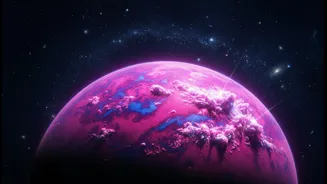
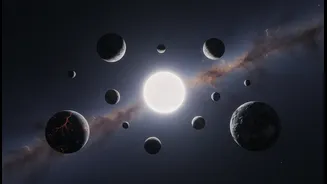
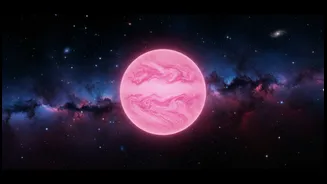
The universe is filled with strange and exotic planets, and Webb is proving to be the ultimate tool for exploring them. Recently, the telescope analyzed the atmosphere of 55 Cancri e, a super-Earth about 41 light-years away that is so close to its star its surface is likely molten lava. The data suggests a hydrogen-rich atmosphere that is likely being constantly replenished by the outgassing of the planet's own magma ocean. In another study, Webb finally cracked the mystery of the 'Pink Planet,' a world 57 light-years away, by detecting salty clouds in its atmosphere—a feature never directly confirmed before in such a cold, planetary-mass object. These findings don't just add to a catalogue of weird worlds; they test and break our models of how planets form and evolve.