






The Moon’s Hidden Sanctuaries
Billions of years ago, when the Moon was still a hotbed of volcanic activity, rivers of lava carved out massive underground tunnels. As the lava flowed away, it left behind hollow conduits known as lava tubes. Scientists have long theorized their existence,
but recent data has provided compelling evidence, revealing collapsed pits or 'skylights' that are likely entrances to these extensive cave systems. Unlike their counterparts on Earth, which are typically 10 to 30 metres wide, lunar lava tubes are potentially colossal, with some estimated to be over a kilometre in width—large enough to house entire cities. These subterranean networks, formed by ancient volcanism, represent more than just a geological curiosity; they are now considered prime real estate for future lunar inhabitants.
A Shield Against the Stars
The lunar surface is an incredibly dangerous place for long-term settlement. With virtually no atmosphere, it is constantly bombarded by deadly cosmic rays from deep space and intense solar radiation. It also faces a continual threat from micrometeorite impacts and experiences wild temperature swings. However, the thick basaltic rock ceilings of lava tubes offer a natural and effective solution. Researchers estimate that the several metres of solid rock overhead would drastically reduce radiation exposure to safe levels, providing a built-in shelter that would otherwise need to be constructed and transported from Earth at enormous expense. Within these tubes, the temperature is also remarkably stable, hovering around a chilly but manageable -20°C, a stark contrast to the extreme fluctuations on the surface.
Robots Going Underground
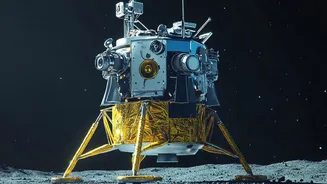
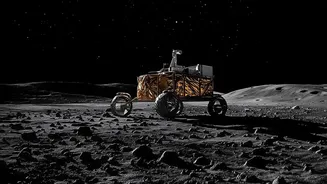
Before humans can set up camp, we need to know what we're getting into. That's where a new generation of subterranean rovers comes in. Both NASA and the European Space Agency (ESA) are funding projects to develop robots capable of exploring these challenging environments. One concept, the Lunar Underground eXplorer (LUX), proposes a hovering drone that would be lowered into a pit tethered to a surface rover. This tether would uniquely provide power via a laser-over-fibre optic cable, enabling long-duration exploration and high-speed data transmission without contaminating the pristine cave environment. Other proposals involve teams of autonomous robots working together: one to map the entrance, another to lower a probe, and a third to explore and create 3D maps of the interior. These robotic scouts are crucial first steps in verifying the structural integrity and resource potential of the tubes.
The Subterranean Challenge
Exploring a lunar lava tube is far from simple. These environments are completely dark, unmapped, and lack the GPS that guides terrestrial drones. The rovers must be able to navigate treacherous, unknown terrain autonomously, rappel down sheer pit walls, and operate without solar power once inside. The communication link is another hurdle; data must be reliably relayed from deep within a cave back to a lander on the surface. To tackle these issues, agencies are testing multi-robot systems. For instance, the ESA has explored concepts where a swarm of smaller robots works collectively, and NASA-led teams have developed diverse robots that can walk, drive, or fly to navigate complex spaces. The technologies being developed for these missions have applications not just for space, but also for first responders in GPS-denied environments on Earth.