

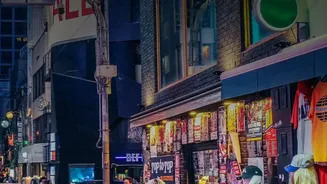
There’s no better way to understand a city’s soul than by walking its streets. Some are arteries of history, others are canvases for art, but all offer a unique story. Here are ten streets around the world that truly reward exploring on foot.
Hosier Lane, Melbourne, Australia
A walk down
Hosier Lane is a dive into Melbourne’s vibrant, chaotic, and ever-changing creative spirit. This cobbled laneway is an internationally renowned street art gallery, where every surface is covered in a riot of colour. The art is in constant flux; a masterpiece you see one day might be painted over the next, making every visit a unique experience. Since the late 1990s, this lane has served as a de facto canvas for local and international artists, its walls layered with everything from detailed murals and political stencils to playful paste-ups. It’s a sensory overload in the best way possible, capturing the raw, energetic pulse of the city’s subculture just a stone's throw from the formal architecture of Federation Square.
The Shambles, York, England
To stroll down The Shambles is to step directly into medieval England. As one of the best-preserved medieval streets in the world, its history dates back to the 14th century. The name comes from 'fleshammels', the shelves on which butchers once displayed their meat. The timber-framed buildings lean so dramatically that they almost touch overhead, a design that once sheltered the meat from the sun. While the butchers are long gone, you can still spot original meat hooks on some storefronts. Today, the narrow, cobbled lane is filled with quirky shops and cafes, and its magical atmosphere is so potent that it's often compared to Diagon Alley from the Harry Potter films.
Via dei Fori Imperiali, Rome, Italy
It’s hard to find a walk more steeped in history than Via dei Fori Imperiali. This grand boulevard connects Piazza Venezia to the Colosseum, cutting straight through the heart of the ancient Roman Empire. As you walk, you are flanked by the ruins of the Imperial Fora—the political, commercial, and social centres of ancient Rome. You'll pass the Forum of Trajan, the Temple of Venus and Genetrix, and countless other remnants of a powerful civilization. On certain days, the street is fully pedestrianised, allowing you to wander freely and soak in the epic scale of your surroundings without the noise of traffic. Lined with iconic pine trees, it offers a truly monumental stroll through two millennia of history.
Shibuya Crossing, Tokyo, Japan
Walking Shibuya Crossing isn't just a way to get from A to B; it's an experience in itself. Often called the world's busiest pedestrian intersection, up to 3,000 people surge into the 'scramble' every time the lights change. It’s a mesmerizing spectacle of organised chaos, surrounded by towering neon billboards and giant video screens. For a first-time visitor, stepping into the stream of humanity feels like being on a movie set. The best way to appreciate it is to cross it yourself, then find a viewpoint—like the Starbucks overlooking the intersection—to watch the incredible, rhythmic flow of people from above. It perfectly encapsulates the energy of modern Tokyo.
Lombard Street, San Francisco, USA
Famous as the 'crookedest street in the world', the one-block section of Lombard Street on Russian Hill is a quirky San Francisco icon. Its eight sharp, hairpin turns were designed in 1922 to make the steep hill navigable for cars. While driving down is a popular tourist activity, walking it offers a different perspective. Pedestrian staircases run along both sides of the street, allowing you to admire the beautifully manicured flowerbeds, especially the hydrangeas, that fill the gaps between the red-brick switchbacks. From the top, you get fantastic views of the bay and Coit Tower, making the steep climb well worth the effort.
The Blue Streets of Chefchaouen, Morocco
It’s not one single street but an entire city maze that captivates in Chefchaouen, Morocco's 'Blue Pearl'. Nestled in the Rif Mountains, the old medina is a dreamscape of buildings washed in every shade of blue imaginable. There are several theories for the colour—some say it was introduced by Jewish refugees in the 1930s to symbolize the sky and heaven, while others believe it helps keep mosquitoes away. Getting lost in its narrow, winding alleyways is the best way to explore. Every corner reveals a new photo-worthy scene: a colourful flowerpot against an azure wall, a beautifully carved door, or a cat napping on a blue step.
Rue Crémieux, Paris, France
A short, charming escape from the grand Haussmannian boulevards, Rue Crémieux in the 12th arrondissement is a pastel-coloured dream. This quiet, cobbled, pedestrian-only street is lined with houses painted in soft pinks, blues, greens, and yellows. The colourful makeover happened in 1993 when residents, asked to renovate their facades in exchange for the street being paved, decided to coordinate a rainbow of colours. Adorned with potted plants and artistic details, it feels more like a quaint village lane than a street in central Paris. Its unique charm has made it an Instagram sensation, but its real appeal lies in its peaceful, picture-perfect atmosphere.
Long Street, Cape Town, South Africa
True to its name, Long Street is a lengthy, energetic artery running through Cape Town's City Bowl. It’s famous for its bohemian vibe and beautifully preserved Victorian-era buildings with their distinctive wrought-iron balconies. By day, it’s a bustling hub of independent bookstores, antique shops, and eclectic cafes. As night falls, the street transforms into one of the city’s primary nightlife destinations, with a dense concentration of bars, pubs, and clubs that buzz with energy until the early hours. It’s a place where you can feel the city’s pulse, day or night, surrounded by a vibrant mix of locals and travellers.
Caminito, Buenos Aires, Argentina
Located in the La Boca neighbourhood, Caminito (meaning 'little path') is a vibrant open-air museum. In the 1950s, local artist Benito Quinquela Martín began painting the drab walls of the abandoned street with bright colours, transforming it into a cheerful, artsy strip. The buildings, made of wood and corrugated iron, reflect the style of the early Genoese immigrants who settled here. Today, the street is filled with artists selling their work, tango dancers performing for crowds, and quirky statues peering down from balconies. It’s a short but incredibly lively walk that celebrates the neighbourhood’s working-class roots and artistic soul.
Acorn Street, Boston, USA
Often cited as the most photographed street in the United States, Acorn Street in Boston’s Beacon Hill neighbourhood is a journey back to colonial America. This narrow lane is paved with original cobblestones, and the gaslit lamps and Federal-style brick row houses transport you to another era. The street is charmingly small and remarkably preserved, offering a quiet, picturesque glimpse into 19th-century Boston. It’s a residential street, so it’s important to be respectful, but taking a moment to walk its historic stones is a quintessential Boston experience that feels worlds away from the modern city around it.