






The Basic Rule: Bigger is Easier to Spot
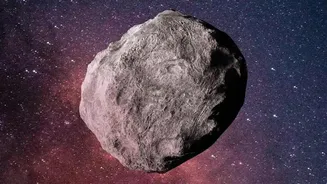
When it comes to spotting asteroids, size is the most critical factor. The fundamental principle is simple: larger objects reflect more sunlight, making them appear brighter and thus easier for telescopes on Earth and in space to detect. The global network
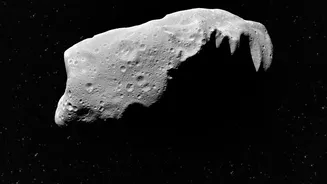
of asteroid-hunting surveys is primarily designed to find these larger bodies. Astronomers believe they have already located more than 95% of the near-Earth asteroids that are a kilometre or larger in diameter — the kind of “planet-killer” that could cause a global catastrophe. These giants are so bright that they can be discovered and tracked years, or even decades, before they might pose a threat, giving humanity ample time to potentially intervene.
The Dangerous Blind Spot: City-Killers
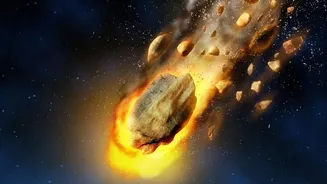
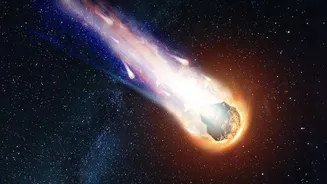
The most significant challenge for planetary defense lies with medium-sized asteroids. Objects ranging from a few dozen metres up to about 140 metres (roughly 460 feet) are large enough to obliterate a city or cause devastating regional damage, but they are much harder to detect. An asteroid around 20 metres wide exploded over Chelyabinsk, Russia, in 2013, creating a shockwave that injured over 1,500 people and damaged thousands of buildings. It was not detected before entering the atmosphere because it was relatively small and, crucially, approached from the direction of the sun, hiding in its glare. Rocks smaller than about 25 metres will likely burn up entirely in the atmosphere, but anything larger can pose a significant local hazard. There are an estimated 25,000 near-Earth asteroids in this 140-metre-plus size range, but as of late 2025, only a fraction of them had been found.
It’s Not Just Size That Matters
While size is paramount, other characteristics also influence an asteroid's detectability. An object's composition plays a key role; some asteroids are dark like charcoal and reflect very little light, making them nearly invisible to optical telescopes. Others are made of dense metals and can be smaller yet still survive atmospheric entry. The asteroid's trajectory is another major factor. As the Chelyabinsk event showed, objects approaching from the sunward direction are a major blind spot for ground-based telescopes, which operate at night. Speed also matters. A faster-moving object spends less time in a telescope's field of view, making it harder to spot and track long enough to calculate an accurate orbit.
Our Planetary Guard Dogs
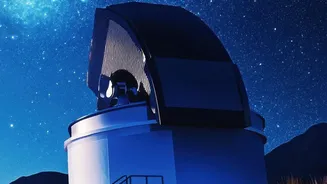
A global network of observatories, coordinated by groups like NASA's Planetary Defense Coordination Office (PDCO), constantly scans the skies for potential threats. Major survey programs like the Catalina Sky Survey and Pan-STARRS use ground-based optical telescopes to take repeated images of the night sky, using software to identify moving objects against the background of stars. These surveys are responsible for the vast majority of asteroid discoveries. However, they are limited by weather, daylight, and the sheer vastness of the sky. While very small impactors are sometimes detected just hours beforehand, the current system is geared toward finding the large asteroids with long warning times, leaving a gap for smaller, unpredicted impactors.
The Next Generation of Asteroid Hunters
To close this dangerous detection gap, a new generation of technology is being deployed. NASA's upcoming NEO Surveyor is a space-based telescope set to launch no earlier than 2027. It will be positioned at a stable point between the Earth and Sun, allowing it to spot asteroids that are currently hidden in the Sun's glare. Crucially, NEO Surveyor will detect infrared radiation — the heat that asteroids emit after being warmed by the Sun. This allows it to find asteroids regardless of how dark or non-reflective they are. This mission, along with powerful new ground-based observatories, is expected to drastically accelerate the discovery of those elusive, city-killer-sized objects, fulfilling the goal of finding the vast majority of asteroids 140 metres and larger.