



A Cosmic Wake-Up Call
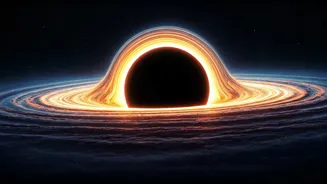
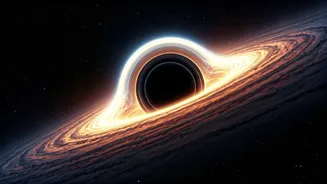
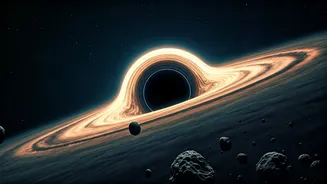
A 'waking' or dormant black hole is a supermassive black hole that has been inactive, meaning it hasn't been actively consuming large amounts of gas and dust. For long periods, these giants can lurk quietly at the centers of galaxies. However, if a star
or a large gas cloud strays too close, the black hole's immense gravity ensnares it in a process called a tidal disruption event (TDE). The star is violently pulled apart, or 'spaghettified', and the resulting debris forms a glowing, superheated accretion disk as it spirals into the black hole. This sudden feeding frenzy causes the black hole to 'wake up', releasing a tremendous amount of energy and light that can outshine all the stars in its galaxy combined. Astronomers have recently observed this happening, giving them a real-time look at a process that was once only theoretical.
An Unlikely Planetary Nursery
For a long time, the standard model of planet formation was clear: planets form in the relatively stable, disc-shaped clouds of gas and dust surrounding young stars, known as protoplanetary disks. The turbulent, high-energy environment around a supermassive black hole was considered the last place you'd expect to find a planetary nursery. However, recent studies and computer models are turning this idea on its head. Scientists now theorize that the vast accretion disks around active galactic nuclei (AGN)—the brilliant centers of galaxies powered by feeding supermassive black holes—could be fertile ground for planet formation. Although the inner regions are chaotic, the cooler, outer edges of these massive disks may have conditions surprisingly similar to the protoplanetary disks around stars.
Rewriting the Rules of Creation
The implications are staggering. While a disk around a star might form a handful of planets, the sheer scale and material wealth of an AGN disk could lead to the birth of millions of planets. These wouldn't be small, rocky worlds like Earth, but massive gas giants, many times the mass of Jupiter. The mechanism, known as 'streaming instability', allows dust to clump together rapidly into planet-forming filaments. Some evidence for this process comes from observations of gas clouds, like one plunging toward our own galaxy's supermassive black hole, which are believed to be the remnants of a protoplanetary disk that was torn from its parent star. This suggests that not only can planets form in these extreme locations, but the building blocks of planets can survive surprisingly close encounters with black holes. These discoveries prove that the universe has more than one way to build a solar system, challenging our sun-centric view of how planets come to be.
Blanets: A New Class of World
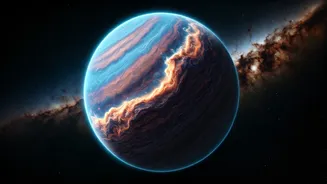
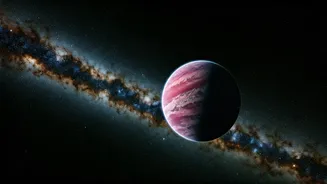
These hypothetical worlds, sometimes nicknamed 'blanets' (black hole planets), would be unlike anything in our solar system. Formed in a gas-rich environment under intense radiation, they could grow to enormous sizes and might look like giant 'lava balls' with strange, degenerate cores. Detecting these planets directly is incredibly difficult, but not impossible. Astronomers believe techniques like gravitational lensing, which uses the gravity of a massive object to bend and amplify the light from something behind it, could one day reveal clusters of these exotic worlds orbiting a distant AGN. The study of waking black holes provides the crucial link, showing us the formation of the very accretion disks where these blanets might be born. By observing a black hole as it consumes a star or gas cloud, scientists are essentially watching the setup for a new, unconventional type of planetary system formation.