
Untangling Day vs. Year
Before we dive into Venus’s bizarre schedule, let's clarify our terms. For us on Earth, a ‘year’ is the time it takes our planet to complete one full orbit around the Sun—about 365 days. A ‘day’ is the time it takes for Earth to complete one full rotation
on its axis—about 24 hours. This relationship seems simple and intuitive, but the cosmos doesn’t always follow our terrestrial logic. On Venus, these two fundamental cycles are locked in a strange and sluggish dance that turns our assumptions upside down.
Venus by the Numbers
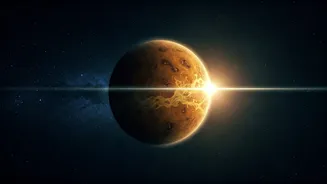
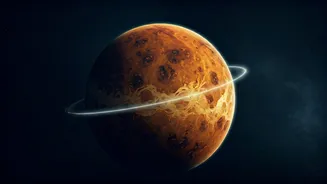
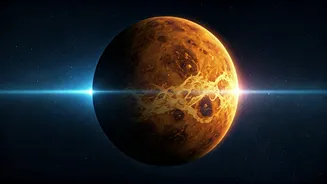
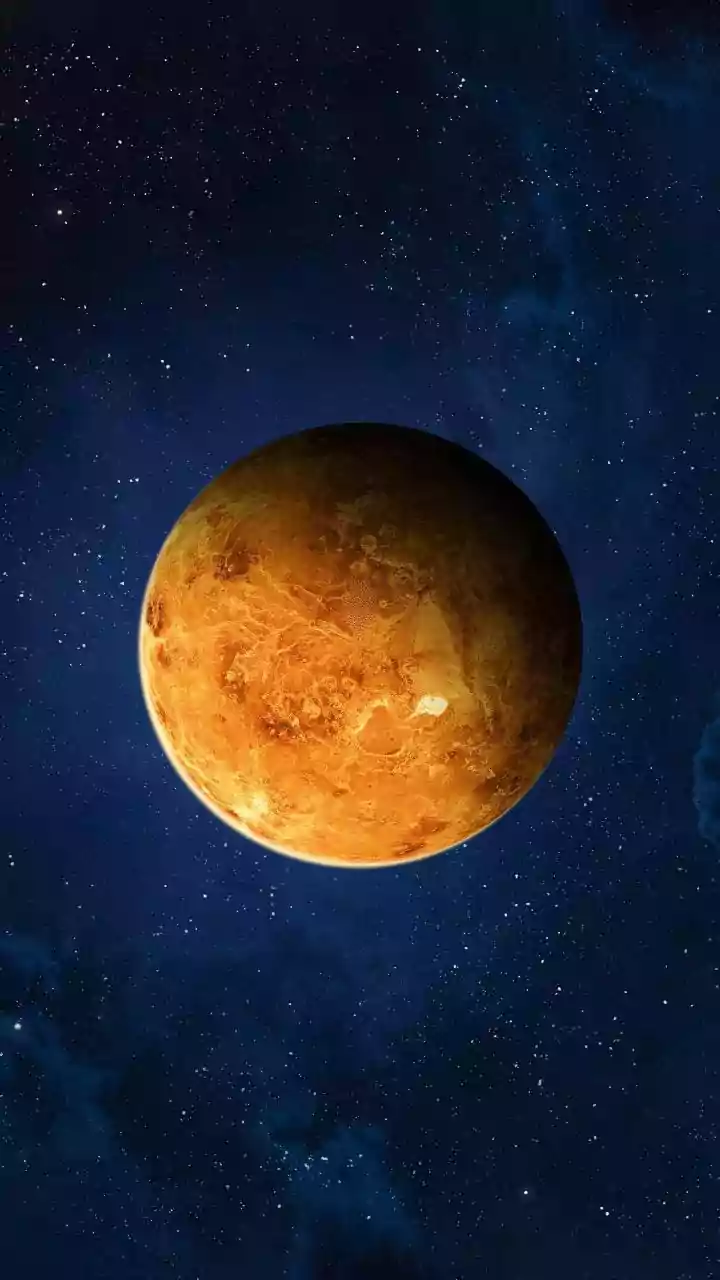
Here is where the mind-bending reality sets in. A year on Venus—its journey around the Sun—takes approximately 225 Earth days. This is its orbital period. Now, for the day. A single, full rotation on its axis, known as a sidereal day, takes Venus a staggering 243 Earth days. That’s right: it takes longer for Venus to spin around once than it does for it to travel all the way around the Sun. If you were standing on Venus, a single ‘spin day’ would last longer than your entire year. This makes Venus unique in our solar system, a planet where the day literally outlasts the year.
The Secret: Slow and Backwards
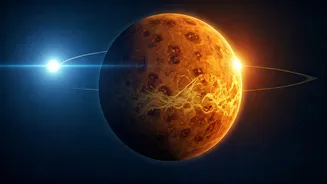
So, why is Venus so different? The answer lies in two key factors: its speed and its direction of rotation. Firstly, Venus spins incredibly slowly. While Earth completes a rotation in 24 hours, Venus lazily drifts through its spin over 243 days. Secondly, and perhaps even more strangely, Venus spins backwards. This is known as retrograde rotation. Every planet in our solar system orbits the Sun in the same direction, and most of them also spin on their axis in that same direction (counter-clockwise, if you look down from above the Sun’s north pole). Venus, however, spins clockwise. Scientists are still debating why, with leading theories pointing to a massive collision early in its history or the powerful gravitational pull of its thick atmosphere creating a drag over billions of years.
But What About Sunrise to Sunrise?
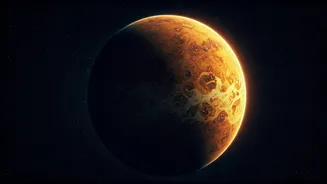
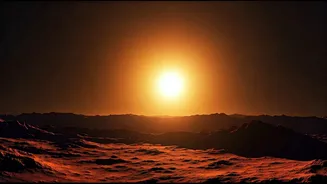
This is where it gets even weirder. The term ‘day’ can also mean the time from one sunrise to the next, which is called a solar day. Because Venus is rotating backwards as it moves forward in its orbit around the Sun, these two motions work against each other. The result is a solar day on Venus that is significantly shorter than its rotation period. A Venusian solar day lasts about 117 Earth days. This means that during one Venusian year (225 Earth days), the Sun will rise and set not once, but twice. You’d experience two 'mornings' and two 'nights' in the course of a single year, even though each of those day-night cycles lasts for months.
Just One Feature of a Hellish World
This bizarre timekeeping is just one of many extreme characteristics of Venus. Often called Earth's 'twin' due to its similar size and mass, Venus is anything but hospitable. Its atmosphere is a crushing force, with surface pressures over 90 times that of Earth—equivalent to being nearly a kilometre deep in our ocean. The air is thick with carbon dioxide and clouds of sulfuric acid, trapping heat in a runaway greenhouse effect. Surface temperatures hover around a scorching 465°C, hot enough to melt lead. This extreme environment may even be responsible for its slow rotation, as the thick, heavy atmosphere could be acting as a constant brake on the planet’s spin. The long days and nights contribute to this thermal nightmare, with no rapid rotation to help circulate heat.