





A Cosmic-Scale Detective Story
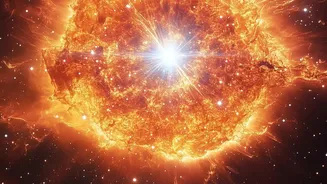
Cosmic rays are not actually 'rays' but physical particles—mostly protons and atomic nuclei—traveling at nearly the speed of light. They are hurled across the cosmos by cataclysmic events like supernova explosions and the environments around supermassive
black holes. Studying them gives us a unique window into these extreme phenomena. However, there's a problem. Because these particles are electrically charged, their paths are bent and scrambled by the magnetic fields that crisscross our galaxy and intergalactic space. By the time a cosmic ray reaches Earth, its arrival direction no longer points back to its source, making a direct trace impossible. It’s like trying to find a specific starting point for a river that has taken a thousand winding turns.
Catching a Ghostly Shower
This is where ground-based telescope arrays come into play. Instead of trying to catch the original cosmic ray particle, which is a near-impossible task, these observatories look for its dramatic entrance into our atmosphere. When a high-energy cosmic ray strikes an atom in the upper atmosphere, it triggers a chain reaction, creating a cascade of billions of secondary particles—electrons, muons, and photons—that rain down towards the ground. This phenomenon is known as an 'extensive air shower', and it can spread out over many square kilometres. The ground arrays are not single telescopes but vast networks of detectors spread over huge areas to catch this particle footprint.
Giants on the Ground
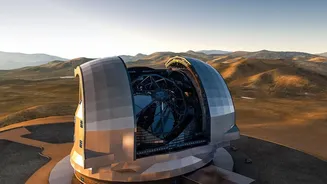
The world's largest cosmic ray observatories are marvels of scientific engineering. The Pierre Auger Observatory in Argentina covers an area of 3,000 square kilometres with 1,600 water-Cherenkov detectors. Each station is a tank of ultra-pure water that produces a faint flash of light when a shower particle passes through it. In Utah, USA, the Telescope Array project uses a similar grid of 'scintillator' detectors combined with fluorescence telescopes that watch for the faint ultraviolet light the air shower produces in the atmosphere on moonless nights. By measuring the precise arrival time of shower particles at different detectors, scientists can reconstruct the direction and energy of the original cosmic ray with incredible precision. These massive projects, involving international collaborations, are slowly building a map of where the most energetic particles in the universe are coming from.
India’s Eye on the Cosmic Storm
India is a key player in this global quest. Located in Ooty, Tamil Nadu, the GRAPES-3 (Gamma Ray Astronomy PeV EnergieS phase-3) experiment is one of the world's most advanced cosmic ray monitoring facilities. Operated by the Tata Institute of Fundamental Research (TIFR) in collaboration with Japanese universities, GRAPES-3 consists of an array of about 400 scintillator detectors spread over 25,000 square metres, coupled with a massive muon detector. This unique setup allows scientists not only to study air showers but also to differentiate between different types of primary particles. The facility has made significant findings, including discovering a new feature in the cosmic ray proton spectrum, which provides crucial clues about how these particles are accelerated within our galaxy and showcases India's capability in building and operating world-class scientific instruments.