






Gather Your Essential Tools
Before you head out, gather your observation kit. First, the journal itself. A simple spiral notebook works well, but a three-ring binder allows you to add pre-printed forms or sketching paper. Consider one for rough notes at the telescope and a neater
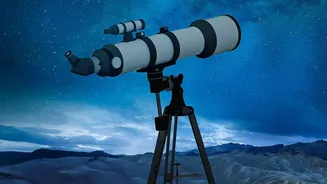
one for final entries at home. You’ll need a graphite pencil for sketching (it's erasable) and a pen for notes. Most importantly, use a red-light torch; a regular white light will ruin your night vision, which can take up to 30 minutes to fully adapt to the dark. Finally, have your viewing instrument ready, whether that's a pair of binoculars or a telescope.
Record the Fundamental Data
Every journal entry should begin with the basics to give your observation context. Start with the full date and the time of your observation. For consistency, many seasoned astronomers use Universal Time (UT). Note your location, as it affects what you see. Crucially, record the sky conditions. This includes 'seeing' (the stability of the atmosphere, often rated on a scale) and 'transparency' (how clear the sky is). Mention any weather issues like haze, clouds, or strong moonlight, as these will directly impact the quality of your view. This data helps you understand why Saturn might look crystal clear one night and blurry the next.
The Art of the Astronomical Sketch
Sketching what you see is one of the most powerful ways to improve your observing skills. It forces you to look closer and notice details you might otherwise miss. You don’t need to be an artist. Start by drawing a circle to represent your field of view. When observing a planet like Saturn or Jupiter, sketch its position relative to nearby stars you can see. This is key for tracking its movement. Over several nights, you'll see the planet shift its position against these 'fixed' background stars. For the planet itself, try to capture its basic shape and any prominent features. The goal is to create an accurate visual record of what you saw through the eyepiece.
Observing the Ringed Planet: Saturn
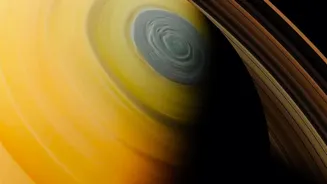
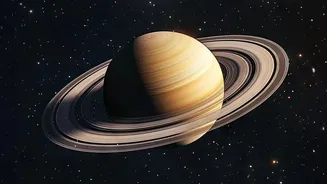
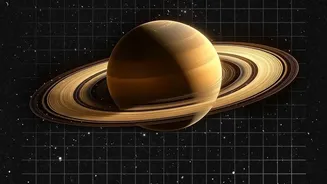
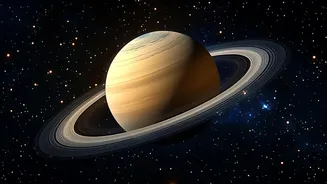
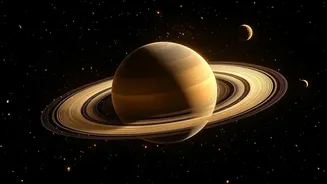
Saturn is a spectacular target. When journaling your observations, note specific details. Describe its colour, which is typically a pale, yellowish-white. Estimate its brightness. Through a telescope, even at low power, you can see the famous rings. Note their tilt. The rings change their angle relative to us over many years, sometimes appearing wide open and other times nearly edge-on. With a magnification of around 100x, try to spot the Cassini Division, a dark gap between the main A and B rings. Also, look for Saturn's largest moon, Titan, which appears as a small star-like point of light nearby. Noting these details will make your journal a rich record of the planet's appearance.
Tracking Movement Across the Sky
The true magic of journaling comes from tracking planets over time. The 'wanderers' of the night sky, planets move against the backdrop of stars. By making regular observations and sketches every few nights or once a week, your journal will reveal this motion. Your series of sketches, each dated and timed, will show Saturn, Jupiter, or Mars moving slowly along its orbital path. This process turns you from a casual viewer into a systematic observer. You are not just seeing a planet; you are actively documenting its journey through the solar system as seen from your own backyard. It's a simple yet powerful way to connect with the celestial mechanics that govern our universe.