




Meet the Real Comet ATLAS
While headlines can sometimes get tangled, the celestial object causing all the excitement is Comet C/2023 A3 (Tsuchinshan–ATLAS). Let's break that name down. It was discovered in early 2023 by two separate astronomy projects: the Tsuchinshan Observatory
in China and the Asteroid Terrestrial-impact Last Alert System (ATLAS) in South Africa. The 'C' indicates it's a non-periodic comet, meaning it either won't return to the inner solar system or will take thousands of years to do so. The name '3I/ATLAS' in the headline is likely a point of confusion; the 'I' designation is reserved for interstellar objects from outside our solar system, like ‘Oumuamua (1I) and Borisov (2I). Comet C/2023 A3 is very much one of our own, hailing from the Oort Cloud, a vast, icy sphere of debris at the extreme edge of our solar system.
What Makes a Comet a Comet?
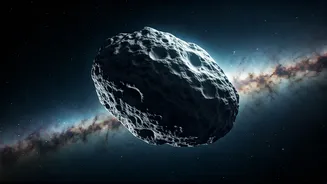
At its heart, a comet is often called a 'dirty snowball.' It's a frozen chunk of gas, rock, and dust left over from the formation of the solar system billions of years ago. For most of its life, as it orbits far from the Sun, a comet is just a dark, inert lump. The magic happens when its orbit brings it into the inner solar system. As it gets closer to the Sun, the intense solar radiation heats the comet's icy nucleus. This process, called sublimation, turns the ice directly into gas, which spews outward, carrying dust with it. This creates a glowing, fuzzy cloud around the nucleus called a 'coma.' The solar wind and radiation then push this gas and dust away from the Sun, forming the iconic long tails—a bluish gas tail and a whitish dust tail—that can stretch for millions of kilometres across space.
A Long Journey and a Fiery Pass
Comet Tsuchinshan-ATLAS is on an epic journey. It has travelled for thousands, if not millions, of years from the frigid darkness of the Oort Cloud. Its path is taking it on a huge loop through our solar system. The most critical part of its journey will be its perihelion, or closest approach to the Sun, on September 28, 2024. During this pass, it will be heated intensely, which is expected to make it significantly brighter. After swinging around the Sun, it will make its closest approach to Earth on October 12, 2024. This combination of being heated by the Sun and then passing relatively close to us is why astronomers are so optimistic about its potential visibility.
Why This Comet Could Be Special
The excitement around C/2023 A3 stems from its potential to become a 'great comet'—a term for comets that become exceptionally bright and easily visible to the naked eye. Based on its size and trajectory, some predictions suggest it could become as bright as the brightest stars in the sky, possibly even visible during twilight. However, comets are notoriously unpredictable. They can fizzle out unexpectedly or break apart as they near the Sun. Think of it like a cosmic firework; you know it has potential, but you won't know how spectacular it is until it actually goes off. Astronomers are watching it closely, but for now, the possibility of a stunning celestial show is enough to build anticipation worldwide.
How to See It From India
For observers in India and the rest of the Northern Hemisphere, the prime viewing window is expected to be in late September and, especially, early to mid-October 2024. In late September, it will be visible in the morning sky just before sunrise. The real show, however, is predicted for the evenings of mid-October, after it has passed the Sun and is moving away. You'll want to look towards the western horizon shortly after sunset. While there's a chance it could be bright enough to see with the naked eye from areas with low light pollution, a good pair of binoculars or a small telescope will dramatically enhance the view, revealing the coma and possibly even its faint tail. Keep an eye on astronomy news as the dates approach for more precise viewing instructions.