


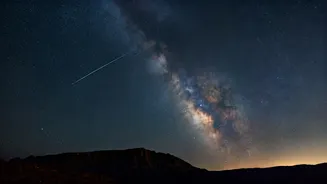
The Startling Numbers
The headline-grabbing claim sounds like science fiction, but the maths is surprisingly simple. Under ideal, dark-sky conditions, the human eye can see between 2,500 and 4,500 stars at any one time. In contrast, the number of active satellites is exploding.
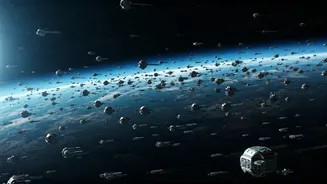
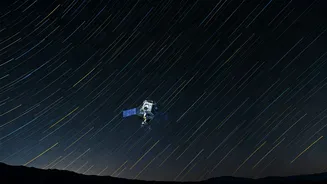
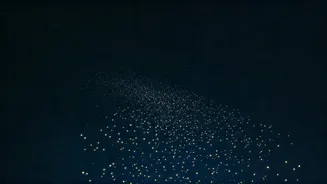
As of mid-2026, there are over 14,500 active satellites in orbit, a number that has grown exponentially from just over 2,000 in 2019. But this is just the beginning. Companies have filed plans for constellations that could bring the total to over one million satellites in the coming years. A recent study from the European Southern Observatory (ESO) warns that if these proposals are realized, for a large part of the night, several thousand satellites could be visible, a number similar to the stars seen in good conditions. It's not that satellites will outnumber the trillions of stars in the universe, but they could overwhelm the few thousand we have traditionally been able to see, fundamentally changing our relationship with the night sky.
The Commercial Space Race
What's driving this incredible surge? The primary driver is the race to provide global, low-latency broadband internet from space. The most significant player is SpaceX, whose Starlink constellation already consists of nearly 10,000 active satellites. The company has plans to expand this to 12,000 and has even filed paperwork for tens of thousands more. They are not alone. Amazon's Project Kuiper is deploying its own constellation of over 3,200 satellites to compete directly with Starlink. China is also planning its own large-scale constellation. This new commercial space race is fuelled by the massive potential market for connecting underserved and remote areas across the globe, including in India. These mega-constellations represent a major business opportunity, with the global space economy projected to grow to $1.8 trillion by 2035.
An Astronomer's Nightmare
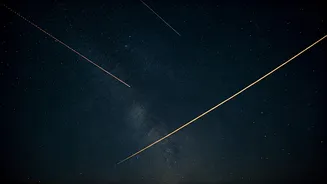
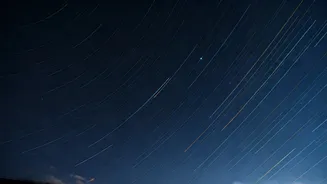
For astronomers, this crowded sky is a looming catastrophe. The sensitive detectors on modern telescopes can be ruined by the bright streak of a passing satellite. Images that require long exposures are particularly vulnerable; a single satellite trail can saturate the detector, rendering the scientific data unusable. This light pollution affects everything from the search for Earth-threatening asteroids to the study of faint, distant galaxies. The International Astronomical Union has stated that an increase in sky brightness of more than 10% over natural levels is an 'astronomy killer'. Some recent studies show that certain proposed satellite networks could increase the overall brightness of the night sky by up to 300 percent. Even space-based observatories like the Hubble Space Telescope are not immune, with forecasts showing they will be increasingly affected.
A Sky Full of Debris
Beyond light pollution, there is the growing risk of orbital congestion and space debris. With tens of thousands of new satellites, the probability of collisions increases dramatically. A collision between two satellites can create thousands of pieces of new debris, each of which becomes a projectile capable of destroying other satellites. This raises the spectre of the Kessler syndrome, a theoretical scenario where the density of objects in low Earth orbit becomes so high that collisions cause a cascade of more collisions, rendering orbit unusable for generations. Current models suggest that with the number of satellites already in orbit, a major collision could be expected every few days if satellites stopped performing avoidance manoeuvres. The more crowded orbit becomes, the higher the risk that this theoretical problem becomes a very real one.
Can the Stars Be Saved?
In response to outcry from the scientific community, some satellite operators, notably SpaceX, have begun working on solutions to reduce the brightness of their spacecraft. These include painting satellites with darker materials, adding sun visors to block reflections, and developing new mirror films that scatter sunlight away from Earth. While these measures have shown some success in dimming the satellites, they have not eliminated the problem entirely. Astronomers argue that regulation, not just voluntary action, is needed. The ESO study suggests a cap of around 100,000 faint satellites as a manageable limit for astronomy. However, with plans for more than ten times that number already on the table, the debate is shifting towards what is an acceptable level of interference and who gets to decide the future of our shared night sky.