



A Cosmic Ghost Story
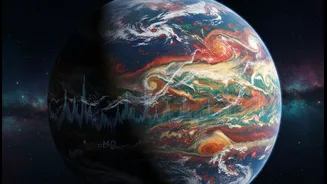
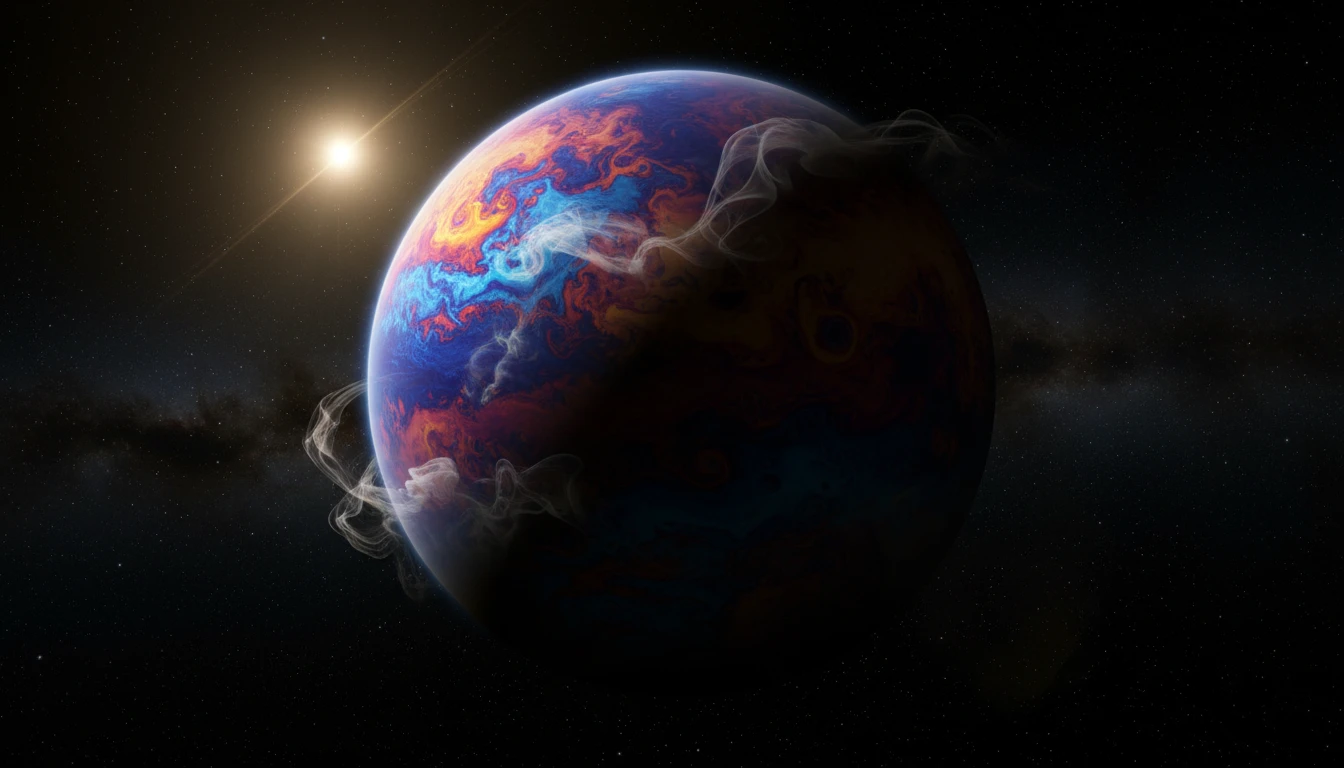
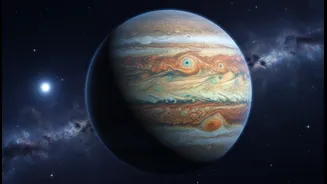
Astronomers have found a planet that shouldn't exist. Located about 80 light-years from Earth, a gas giant named WD 1856 b is orbiting a white dwarf—the tiny, dense remnant of a star that has died. This planet, roughly the size of Jupiter, is seven times
larger than the star it circles. It completes a full orbit in just 34 hours, hugging its star at a distance 50 times closer than Earth is to the Sun. By all accounts, this planet should have been vaporized. When a star like our Sun runs out of fuel, it swells into a red giant, a colossal version of its former self that engulfs and destroys any nearby planets. The fact that WD 1856 b is still there presents a fascinating puzzle.
Surviving the Inferno
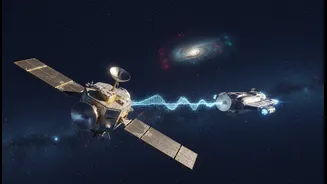
The central question that has baffled scientists is how the planet survived. Standard models of stellar evolution are clear: when its parent star expanded into a red giant, WD 1856 b should have been deep inside the star's fiery atmosphere, where drag would have sent it spiraling to its doom. Its very existence forces a rewrite of the rules. Using NASA's James Webb Space Telescope (JWST), an international team of researchers analyzed the planet's atmosphere for the first time, looking for clues to its past. They found a world far hotter than it should be, suggesting a dramatic history. The leading theory is that the planet wasn't always this close to its star.
A Delayed Arrival
The solution to the mystery seems to be migration. New findings suggest that WD 1856 b spent most of its life in a much safer, wider orbit. It stayed at a comfortable distance while its star went through the violent red giant phase. Then, billions of years after the star had collapsed into a stable white dwarf, something nudged the planet inward. The white dwarf is part of a triple-star system, and the gravitational influence of the other two stars could have been the force that kicked the planet into its current, tight orbit. As it moved closer, the intense gravity of the white dwarf would have heated the planet considerably, explaining its unusually high temperature. It has been cooling ever since. This scenario, a post-destruction migration, is a new twist in our understanding of planetary dynamics.
A Glimpse into Our Future
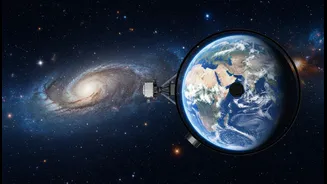
The story of this cosmic survivor offers more than just an astronomical curiosity; it provides an unprecedented glimpse into the distant future of our own solar system. In about five billion years, our Sun will also run out of fuel, swell into a red giant, and then collapse into a white dwarf. For decades, the fate of Earth has been debated. While Mercury and Venus are almost certain to be consumed, recent models suggest Earth might just survive the expansion, pushed into a wider, safer orbit as the Sun loses mass. The survival of WD 1856 b shows that even if a planet endures the initial cataclysm, its journey isn't over. The outer gas giants in our system, like Jupiter and Saturn, will almost certainly survive and could see their orbits change dramatically in the new gravitational landscape.