


A Sweet Find in the Galactic Centre
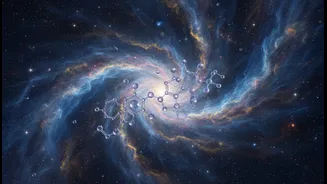
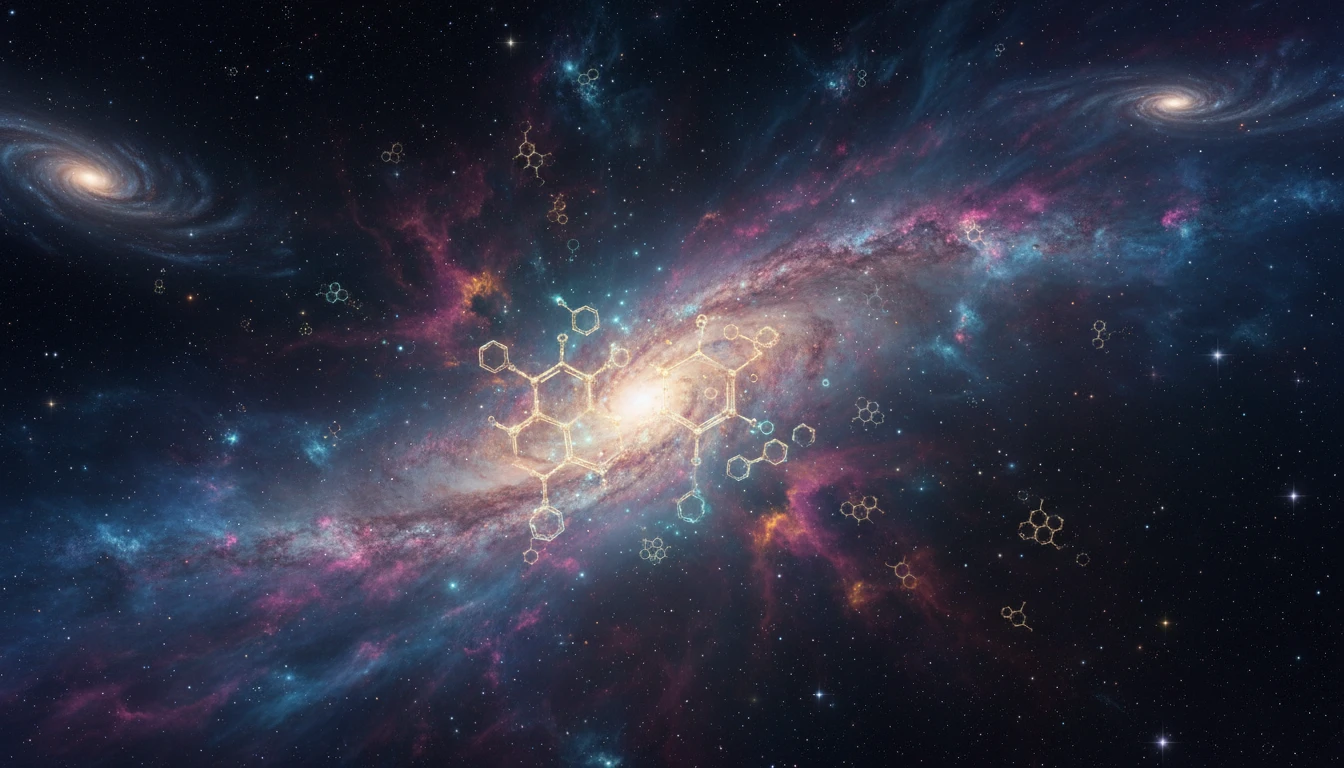
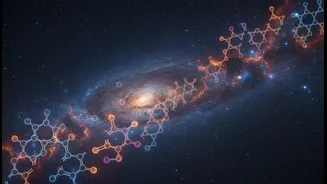
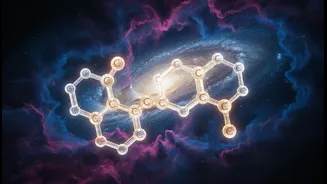
An international team of astronomers has announced the first-ever detection of a sugar molecule, called erythrulose, in the interstellar medium—the diffuse clouds of gas and dust that float between stars. The discovery was made in a dense molecular cloud known
as G+0.693-0.027, located roughly 27,000 light-years away near the centre of the Milky Way. Using powerful radio telescopes in Spain, researchers identified the unique radio-frequency 'fingerprint' of erythrulose, a four-carbon sugar that, on Earth, is naturally found in raspberries. While other simpler organic molecules and even sugars have been found in meteorites or around stars before, this is the first time a sugar has been found in the primordial soup of a stellar nursery, a place where future stars and planets are born.
More Than Just a Sugar Rush
The significance of finding erythrulose in space goes far beyond its simple sweetness. Sugars are fundamental to life as we know it. They are not just a source of energy; they form the structural backbone of RNA and DNA, the molecules that carry the genetic instructions for all living things. The particular sugar that forms the 'R' in RNA is ribose, and finding a related, albeit simpler, sugar like erythrulose suggests that the raw materials for life's essential machinery could be common throughout the galaxy. This discovery provides a compelling clue to a long-standing puzzle in origin-of-life studies. Scientists have struggled to explain how the first sugars could have formed in sufficient quantities on early Earth, as laboratory simulations have proven difficult. This cosmic discovery suggests an alternative: what if the ingredients weren't cooked up on Earth, but were delivered from space?
Cosmic Delivery Service
The presence of erythrulose in a molecular cloud supports the theory of panspermia—not of alien microbes, but of prebiotic molecules. The idea is that the essential building blocks of life formed in these vast interstellar factories and were then incorporated into asteroids and comets billions of years ago. During the early, chaotic history of our solar system, a period known as the Late Heavy Bombardment saw Earth pummelled by these cosmic objects. This celestial bombardment, while destructive, could have seeded the young planet with water, amino acids, and, as we now have reason to believe, sugars like erythrulose. This would have given nascent life a significant head start, providing a ready-made toolkit of complex molecules to begin the journey toward the first cells.
Rewriting the Chemical Recipe
This finding also challenges some existing theories about how complex molecules form in space. The prevailing view was that they grow incrementally, with smaller molecules adding one carbon atom at a time. However, the researchers found a surprising abundance of the four-carbon erythrulose, while detecting no simpler three-carbon sugars in the same cloud. This unexpected result suggests that more complex chemical pathways may be at work in the interstellar medium, perhaps with larger molecular fragments combining directly. It forces scientists to rethink their models of cosmic chemistry and broadens the range of possible reactions that could be producing life's precursors across the universe. This discovery essentially opens a new chapter in astrochemistry, pushing researchers to look for even more complex molecules, such as the five-carbon ribose, which would be an even more direct link to the origins of life.