



A Cosmic Question of Age
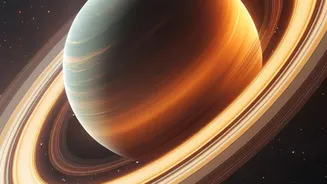
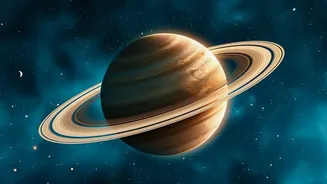
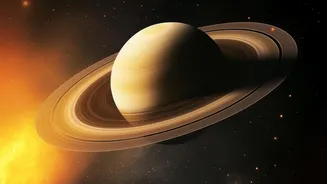
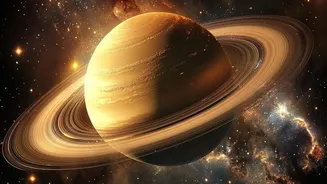
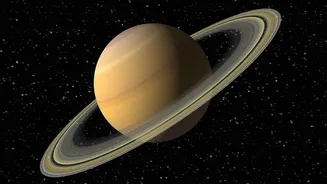
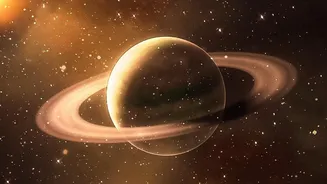
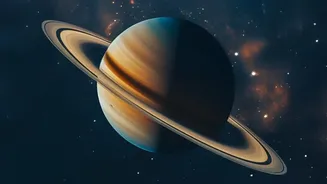
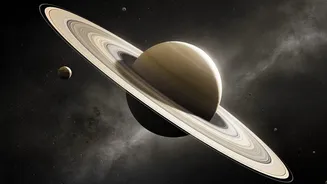
One of the most fundamental and fiercely debated questions is: how old are the rings? For decades, the prevailing theory was that the rings were ancient, forming alongside Saturn itself about 4.5 billion years ago. However, data from NASA's Cassini spacecraft,
which studied the planet from 2004 to 2017, has thrown this long-held belief into chaos. One major clue lies in their composition. The rings are astonishingly pure, consisting of about 99% water ice. Scientists argue that if the rings were truly ancient, they should be much 'dirtier,' having been polluted by a constant bombardment of dark micrometeoroids over billions of years. This line of reasoning suggests the rings may be shockingly young, perhaps only 100 million to 400 million years old. If correct, this means they would have formed when dinosaurs still roamed the Earth. Yet, the debate is far from over. Other recent studies propose that the rings could indeed be ancient, suggesting a cosmic cleaning mechanism might be at play, vaporizing incoming debris and keeping the ice pristine.
The Disappearing Act
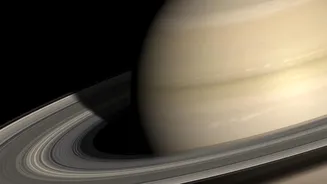
Not only might the rings be young, but they also appear to be temporary. Scientists have discovered a phenomenon dubbed 'ring rain,' where particles from the inner rings are being pulled inward by Saturn's gravity and magnetic field. This isn't a gentle shower; it's a downpour. It is estimated that an amount of water equivalent to an Olympic-sized swimming pool drains from the rings every half hour. Data from Cassini's final orbits revealed this process is happening at a 'worst-case-scenario' rate. Based on this, some projections suggest the entire magnificent ring system could be gone in as little as 100 million years—a mere blink of an eye in cosmic terms. This raises a tantalizing thought: we are incredibly lucky to live in an era when Saturn has its glorious adornment.
The Mystery of the Spokes
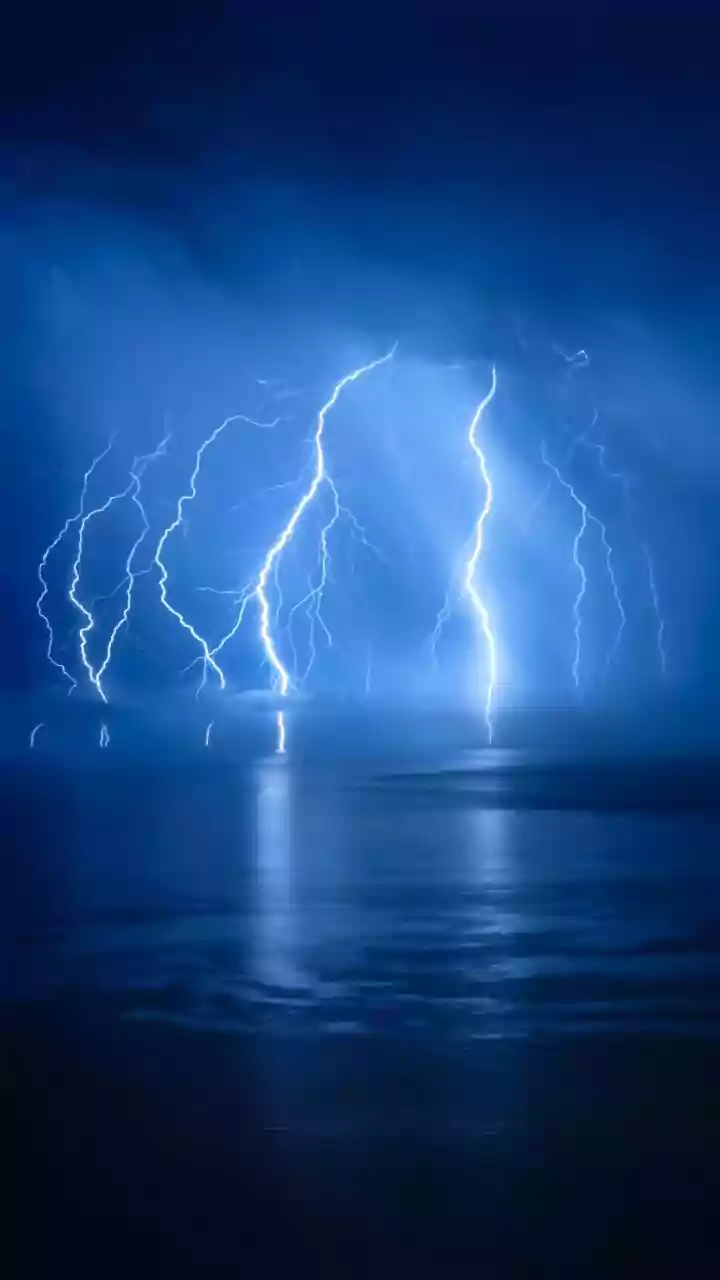
Another perplexing feature is the appearance of mysterious, ghostly 'spokes'—transient, radial markings that stretch across the rings. First spotted by the Voyager spacecraft in the 1980s, these features can be longer than the diameter of Earth and can form and dissipate in just a few hours. Cassini also observed these enigmatic spokes, which seem to appear more frequently around Saturn's equinox. Scientists believe they are composed of tiny, dust-sized ice particles that are lifted above the main ring plane by an electrostatic charge, possibly linked to Saturn's powerful magnetic field or even lightning in its atmosphere. However, the precise mechanism that creates and controls their behaviour remains one of the rings' most stubborn secrets.
What Comes Next?
Answering these profound questions requires getting closer—and even touching the rings themselves. The Cassini mission provided an unprecedented wealth of data, but it was not designed to sample the rings directly. Scientists and engineers are now dreaming up future missions that could. One ambitious concept, known as PRAXIS, proposes using an AI-guided spacecraft to autonomously navigate the treacherous ring system and physically collect particles for analysis. Such a mission is still in the very early stages of planning but highlights the scientific desire to solve these puzzles. In the more immediate future, NASA's Dragonfly mission is scheduled to launch in 2028 to explore Saturn's largest moon, Titan, continuing our exploration of this complex and fascinating planetary system. Until a dedicated ring mission is launched, the secrets of Saturn will continue to be a powerful reminder of how much we still have to learn about our own solar system.