





The Horizon Moon and the Age-Old Question
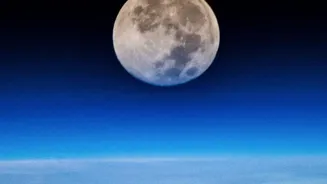
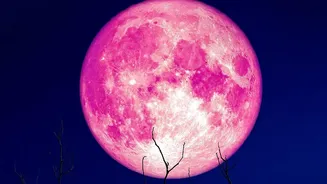
It’s one of nature’s most cinematic moments. A full moon rising over a city skyline, a distant mountain range, or the ocean’s edge appears breathtakingly large and vividly coloured. Hours later, the same moon, now high in the night sky, looks noticeably
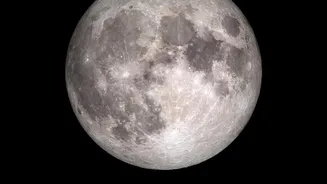
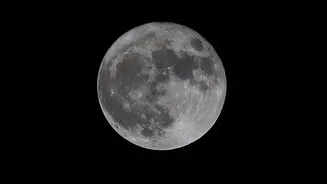
smaller and paler. For thousands of years, people have marvelled at this phenomenon, known as the 'Moon illusion'. Aristotle himself pondered it, suggesting Earth’s atmosphere might act like a magnifying glass. This intuitive guess touches on one part of the puzzle—the role of the atmosphere—but as modern science shows, it misses the main reason for the dramatic change in size. The most surprising truth is that the Moon’s apparent size doesn't really change as it rises. Photographs taken with the same camera settings prove that the Moon has the same angular diameter whether it's at the horizon or the zenith. So, if it isn't physically larger, what's going on?
What Atmospheric Physics Actually Does
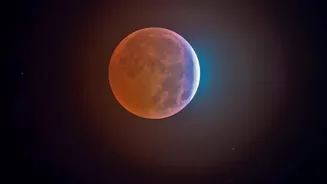
Let’s start by tackling the 'atmospheric bending' part of the headline. Light from the Moon does indeed travel through more of Earth's atmosphere when it’s near the horizon. This has two noticeable, and very real, physical effects. First, it changes the Moon’s colour. The atmosphere scatters shorter, bluer wavelengths of light more effectively, allowing longer, redder wavelengths to reach our eyes. This process, called Rayleigh scattering, is why the horizon moon often appears yellow, orange, or red. The second effect is atmospheric refraction, which bends light rays. This can cause the Moon to appear slightly flattened or distorted, but it doesn't magnify it. In fact, this refraction effect makes the Moon appear vertically squashed, meaning it looks slightly smaller when it is low on the horizon, not larger. So, while the atmosphere is responsible for the beautiful harvest-moon colours, it’s not the culprit behind its perceived giant size.
The Real Culprit: A Glitch in Your Brain
The Moon illusion is almost entirely a psychological phenomenon. It isn't a trick of physics, but a trick of perception. Our brains have spent millennia learning to interpret visual cues to judge size and distance in our three-dimensional world, but these same rules of thumb break down when applied to celestial objects. You can easily prove it’s an illusion. Try holding your thumb out at arm's length; you'll find it covers the Moon just as easily on the horizon as it does when it's high in the sky. Another simple trick is to bend over and look at the horizon moon from between your legs. This simple act of turning the scene upside down often breaks the illusion, causing the Moon to shrink back to its 'normal' size. These tests show us that the 'bigness' is not in the sky, but in our heads.
The Power of the Ponzo Illusion
One of the leading explanations for the Moon illusion is the Ponzo illusion, first described by Italian psychologist Mario Ponzo in 1911. Imagine two identical horizontal lines drawn across a set of converging railway tracks. The line drawn where the tracks are closer together (appearing farther away) will seem much larger than the line drawn where the tracks are wide (appearing closer). Our brain, using the converging lines as a depth cue, assumes that if two objects have the same retinal size but one appears farther away, the 'farther' one must be physically larger. When the Moon is on the horizon, our brain sees it alongside familiar distance cues like trees, buildings, and hills. These objects act like the railway tracks, telling our brain the Moon is very far away. When the Moon is high in the sky, it floats in a vast emptiness with no reference points, so our brain perceives it as closer. Since the Moon's size on our retina is always the same, our brain concludes the 'farther' horizon moon must be enormous.
The Flattened Sky Theory
A related idea is the 'apparent distance' or 'flattened sky dome' hypothesis. This theory suggests that our brains don't perceive the sky as a perfect hemisphere above us. Instead, we see it as a flattened dome, where the horizon feels much farther away than the zenith directly overhead. Think about clouds: clouds directly above you might be only a few kilometres up, while clouds on the horizon could be hundreds of kilometres away. Our brain applies this same logic to the Moon. When we see the Moon low on the 'distant' horizon, our mind's size-constancy mechanism scales it up. When it's at the 'closer' zenith, our brain perceives it as smaller. While there's still debate among psychologists about the precise mechanisms, both the Ponzo and apparent distance theories agree on the core principle: our brain is misapplying rules that normally help us navigate our terrestrial environment.