
The Venusian Veil
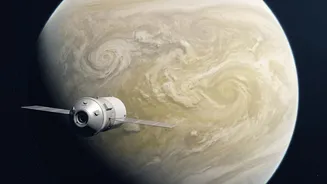
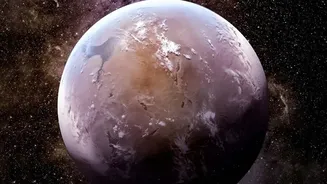
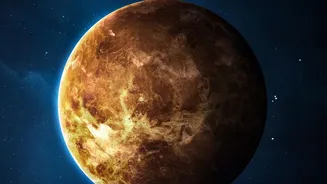
Studying Venus is notoriously difficult. The planet is permanently covered by a dense blanket of clouds made primarily of carbon dioxide with droplets of sulfuric acid. This opaque layer makes it impossible for standard optical cameras to take pictures
of the surface. Furthermore, the surface conditions are extreme, with temperatures hot enough to melt lead and crushing atmospheric pressure. Any spacecraft that has attempted to land has survived for only a short time. This is why orbiting and seeing through the clouds is the primary method for long-term study, a challenge ISRO is tackling head-on with Shukrayaan, which received formal government approval in September 2024.
The All-Seeing Eye: Synthetic Aperture Radar
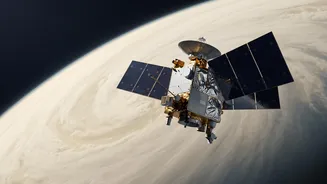
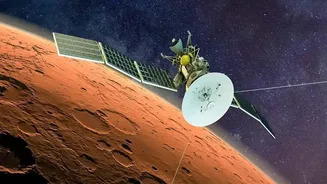
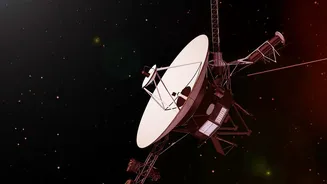
The star instrument of the Shukrayaan mission is a high-resolution Synthetic Aperture Radar, or SAR. Think of it as a form of celestial echolocation. Instead of using light, SAR sends powerful radio waves down to the planet's surface. These radio signals are special because they can pass right through the thick Venusian clouds without being scattered or blocked. Once they hit the ground, the signals bounce off geological features like mountains, volcanoes, and plains, and the radar's antenna catches the returning echo. By precisely timing how long the signals take to return and how strong they are, scientists can construct a detailed, three-dimensional map of the surface. ISRO's instrument, known as VSAR, is designed to have a resolution up to four times better than NASA's Magellan mission from the 1990s, promising an unprecedented look at Venusian geology.
Going Deeper: Ground-Penetrating Radar
Beyond just mapping the surface, Shukrayaan aims to be the first mission ever to look beneath it. It will carry a ground-penetrating radar, an instrument that uses lower-frequency radio waves to probe the shallow subsurface of the planet. This technology is designed to investigate the stratigraphy, or the layering of rock and soil, to a depth of up to a kilometer. By studying these layers, scientists hope to understand the planet's geological history, searching for evidence of past lava flows, buried craters, and tectonic activity. This world-first investigation could provide fundamental new insights into how Venus became the scorching world it is today.
Analyzing the Atmosphere Itself
While the radars focus on the ground, a suite of other instruments will study the atmosphere they have to peer through. One of the key payloads is the Venus Infrared Atmospheric Gases Linker (VIRAL), an instrument co-developed with Russia's space agency and France's CNES. VIRAL is a spectrometer designed to analyze the composition of the upper atmosphere. It will search for specific gases, including phosphine, which was controversially detected years ago and is considered a potential, though highly debated, indicator of biological processes. Other spectroscopic tools will operate in infrared, ultraviolet, and submillimeter wavelengths to study cloud structure, thermal emissions, and the mysterious super-rotation of the planet's atmosphere.
A Collaborative Global Effort
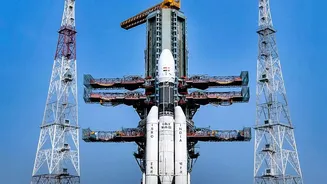
Set for a potential launch in March 2028, the Shukrayaan mission is not just an Indian endeavour. The orbiter will carry a total of 19 scientific instruments, with contributions from multiple international partners. Sweden is contributing an instrument to study the interaction between the solar wind and the Venusian ionosphere. Germany is also collaborating on a payload. This collaborative approach, which brings together diverse expertise and technology, pools global resources to answer fundamental questions about planetary evolution. With its powerful and varied sensor array, Shukrayaan is poised to lift the veil on Earth's twin, providing crucial data that could help us understand not only Venus, but also the long-term evolution of our own planet.