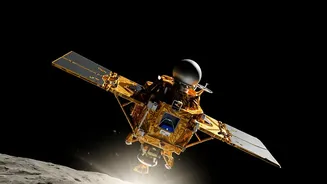




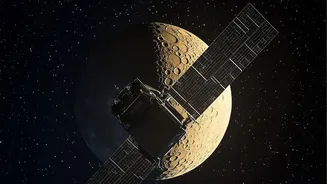
Japan's ambitious Martian Moons eXploration (MMX) mission is set to unravel one of the Red Planet's biggest secrets. A crucial piece of this puzzle will be provided by NASA, in the form of a sophisticated instrument designed to see what the moons are
made of.
A Mission to Solve a Martian Mystery
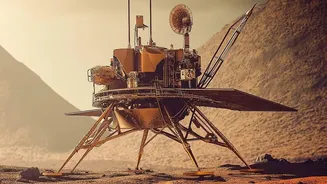
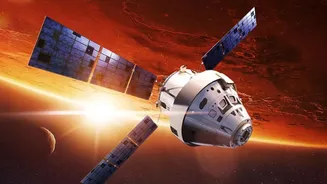
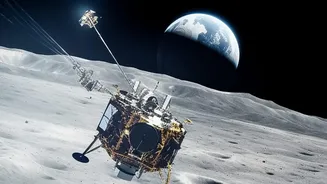
The Japanese Aerospace Exploration Agency (JAXA) is leading an international effort to understand Mars's two small, lumpy moons, Phobos and Deimos. Launched in October 2026, the MMX spacecraft will be the first to orbit Phobos, land on its surface, and, most importantly, return a sample of its soil to Earth in 2031. The central question driving this complex mission is a long-standing debate among scientists: are Phobos and Deimos captured asteroids, or are they fragments of Mars itself, blasted into orbit by a giant impact billions of years ago? Figuring this out could rewrite our understanding of how planets and solar systems form.
Two Moons, Two Competing Theories
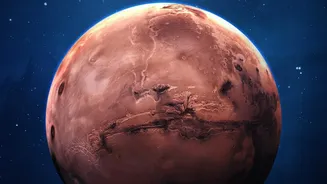
The origin of Phobos and Deimos has puzzled astronomers since their discovery in 1877. On one hand, their dark, cratered, and potato-like appearance suggests they are carbon-rich asteroids that strayed too close to Mars and were trapped by its gravity. However, their orbits are another story. Both moons circle Mars's equator in neat, nearly circular paths, which is not what would be expected from a random capture. This orderly orbit supports the 'giant impact' theory, which posits that a massive object struck Mars in the distant past, creating a debris ring that eventually coalesced into the two moons, much like how Earth's Moon is thought to have formed. The MMX mission aims to finally settle this debate by analysing the moons' composition up close.
NASA's High-Tech 'Eyeglasses'
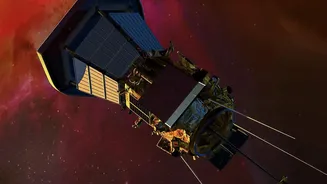
To help solve the mystery, NASA has contributed a key scientific instrument to the MMX mission called MEGANE. The name, which means 'eyeglasses' in Japanese, is an acronym for Mars-moon Exploration with GAmma rays and NEutrons. Developed by a team at the Johns Hopkins Applied Physics Laboratory, MEGANE is a state-of-the-art spectrometer. Its job is not to take pictures, but to determine the elemental composition of Phobos's surface from orbit. By identifying the key elements present and their abundances, MEGANE will provide crucial data to distinguish between the asteroid and giant impact theories. For example, if the moon is rich in materials common to Mars's crust, it would support the impact theory. If it has a more carbon-rich composition, it would point towards a captured asteroid.
How to Read a Moon's Surface
MEGANE works by passively detecting gamma rays and neutrons that are naturally emitted from Phobos's surface. The surface of an airless body like Phobos is constantly bombarded by high-energy cosmic rays from space. When these cosmic rays strike atoms in the soil, they can knock neutrons loose and excite the atomic nuclei. As these nuclei return to their normal state, they release gamma rays with specific energy levels that act as unique 'fingerprints' for each chemical element. MEGANE's sensors will capture these particles and measure their energies, allowing scientists to create a detailed map of the surface elements, such as silicon, iron, potassium, and others. This will not only help solve the origin mystery but also provide essential context for the samples that MMX will collect and return to Earth.
An International Voyage of Discovery
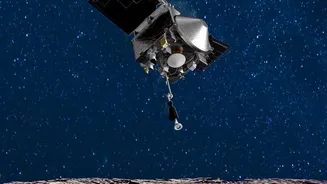
The MMX mission is a global collaboration, involving JAXA, NASA, and European space agencies DLR and CNES. After arriving at Mars in 2027, the spacecraft will spend years studying both moons. It will deploy a small German-French rover named Idefix to explore the surface of Phobos before the main spacecraft lands to collect more than 10 grams of soil. After its observations and sample collection are complete, the spacecraft will begin its long journey home, jettisoning a capsule with the precious cargo to land in Australia in 2031. The analysis of these first ever samples from the Martian system, combined with data from instruments like MEGANE, promises to open a new window into the early history of our solar system.