




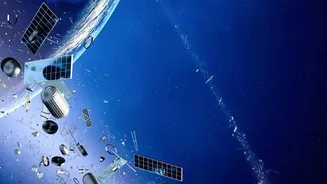
The Junkyard Above Our Heads
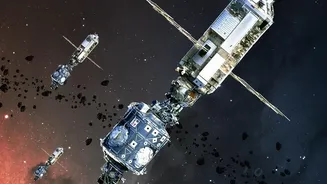
Space isn't as empty as it looks. Decades of launches have left behind a treacherous legacy: a cloud of space debris encircling our planet. This includes everything from defunct satellites and spent rocket stages to tiny fragments from past collisions.
There are an estimated 129 trackable pieces of debris from Indian missions alone, but millions of smaller, untrackable objects are also in orbit. Travelling at speeds of up to 28,000 kilometres per hour, even a centimetre-sized fragment can strike with the force of a bowling ball, capable of disabling or destroying a multi-crore satellite. This orbital junkyard poses a direct threat to the space infrastructure that powers modern life—from GPS navigation and weather forecasting to telecommunications and national security.
From Manual Dodging to AI Reflexes
Until now, protecting satellites has been a manual and resource-intensive process. India's space agency, ISRO, operates a sophisticated surveillance program called Project NETRA to track potential threats. When a dangerous close approach is predicted, engineers on the ground command the satellite to perform a Collision Avoidance Manoeuvre (CAM)—a small engine burn to nudge it out of harm's way. But the problem is growing. ISRO has had to perform these manoeuvres with increasing frequency, executing 29 such evasions in the last 18 months alone. Each burn consumes precious fuel, shortening a satellite's operational lifespan. The sheer volume of threats makes manual intervention unsustainable. The future, as Indian innovators see it, lies in making satellites smart enough to protect themselves.
India's New Autonomous Shield
The solution emerging from India combines two streams of cutting-edge technology: advanced propulsion and artificial intelligence. On one hand, private Indian startups like Bellatrix Aerospace and Manastu Space are building next-generation satellite thrusters. These include highly efficient electric Hall-effect thrusters and eco-friendly 'green' propellants that allow for more precise and frequent manoeuvres without draining fuel reserves. On the other hand, ISRO and other tech firms are developing the AI brains for these systems. This AI software can analyze tracking data in real-time, predict collision paths with greater accuracy than older models, and make the split-second decision to fire the thrusters—all without waiting for a command from Earth. This capability was partly proven with ISRO's successful SpaDeX mission, which demonstrated fully autonomous rendezvous and docking between two satellites.
Securing India's Future in Orbit
Developing this autonomous protection system is not just about safeguarding current satellites; it is about securing India's ambitions as a major space power. With missions like the Gaganyaan human spaceflight program on the horizon and the country's reliance on its satellite constellations for communication and Earth observation, the stakes are incredibly high. An automated defence system frees up human resources, extends the life of valuable space assets, and makes India's satellite networks more resilient. Furthermore, ISRO has declared its goal for a 'Debris Free Space Mission' by 2030, aiming for all Indian space actors to achieve zero debris creation. By pioneering technologies that can autonomously avoid existing debris, Indian companies are positioning themselves as global leaders in space sustainability and traffic management, turning a pressing problem into a technological and commercial opportunity.