


NASA's New Panoramic Eye on the Cosmos
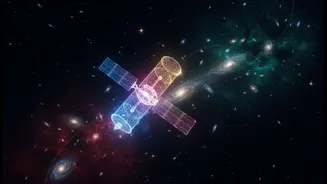
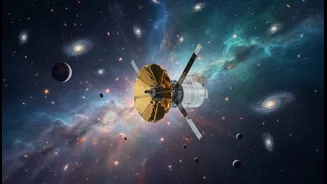
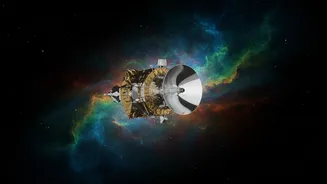
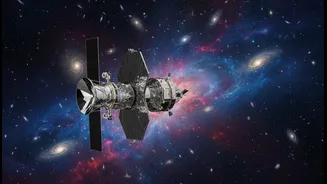
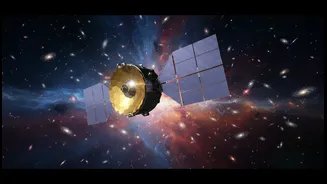
Think of the Roman Space Telescope as a powerful survey machine. While the Hubble and James Webb telescopes provide deep, narrow views of tiny patches of sky, Roman is built for breadth. Its Wide Field Instrument will capture an area of the sky 200 times
larger than Hubble's infrared camera in a single shot. This makes it ideal for creating vast cosmic maps and catching fleeting celestial events. Named after Nancy Grace Roman, NASA's first chief of astronomy, the observatory’s main job is to conduct massive surveys to tackle some of the biggest questions in cosmology. It will create enormous datasets that will keep scientists busy for decades, enabling transformational advances across nearly all of astronomy.
Chasing the Ghost of Dark Matter
One of Roman’s key goals is to investigate dark matter and dark energy, the mysterious components that make up most of our universe. But here’s the first crucial point: Roman will not “see” dark matter. Instead, it will study its effects. The main technique is called weak gravitational lensing. Roman will observe the light from hundreds of millions of distant galaxies and measure how that light is ever-so-slightly distorted by the gravity of unseen dark matter clumps it passes on its way to the telescope. By mapping these subtle distortions across the sky, scientists can create a map of where the dark matter is and learn how it has shaped the cosmos over time. It’s a detective story where the clues are tiny warps in the fabric of spacetime, not a direct photograph of the culprit.
An Exoplanet Census, Not a Travel Brochure
Roman is expected to discover thousands of planets outside our solar system, but the method is as important as the numbers. While it will use the transit method (watching for a star's light to dim as a planet passes in front), its primary technique for planet hunting is gravitational microlensing. This happens when a star with a planet passes in front of a more distant star, and its gravity acts like a lens, briefly magnifying the background starlight. This method is exceptionally good at finding planets far from their star, including worlds analogous to the ice giants in our own solar system and even 'rogue' planets not orbiting any star at all. However, microlensing events are typically one-off occurrences. We get a snapshot that a planet exists, but not the detailed, long-term observations needed to study its atmosphere or specific conditions. Roman’s work will be a statistical census, giving us a much better idea of how common different types of planets are across the galaxy, rather than a detailed study of individual Earth-like worlds.
Mapping a Billion Galaxies in 3D
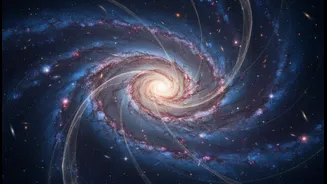
The telescope will undertake several core community surveys, including the High-Latitude Wide-Area Survey. This effort will map the three-dimensional structure of the universe by imaging over a billion galaxies and measuring their distances. These cosmic maps will allow scientists to see how galaxies have clustered together throughout cosmic history. By studying the large-scale structure and tracking how the universe's expansion has changed over time—in part by finding thousands of distant supernovae—Roman will provide crucial data to test our theories about dark energy, the force driving this accelerating expansion. The key takeaway is that Roman is a cartographer, meticulously building a map that will become a foundational resource for other astronomers. The discoveries will come from analyzing this map, a process that will take years of painstaking work.
Appreciate the Process, Not Just the 'Eureka'
The biggest misconception to avoid with a mission like Roman is expecting immediate, earth-shattering answers. Scientific progress is often slow, incremental, and full of uncertainty. The telescope will generate an unprecedented amount of data that will be made public for all astronomers to use. Its findings will help narrow down possibilities for what dark matter could be, tell us if planetary systems like ours are common or rare, and refine our model of cosmic expansion. There will be surprises, but the true legacy of the Roman Space Telescope will be the vast, high-quality datasets it provides. These will fuel discoveries, both big and small, for generations of scientists, helping to build a more complete and complex understanding of our universe.