






Choose Your Night and Location Wisely
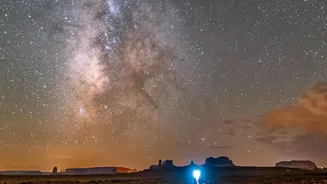
The first step to a successful stargazing session is picking the right time and place. A clear, cloudless night is essential. Autumn air is often less hazy than in summer, giving you a sharper view. Equally important is the moon. A bright full moon acts
like a giant celestial lamp, washing out fainter stars. Try to plan your session during the week of the new moon for the darkest possible skies. Equally crucial is escaping light pollution. The glow from cities and towns can obscure most celestial objects. Use an online light pollution map to find a park, rural area, or designated dark sky spot just a short drive away. Even finding a local park or a field shielded from direct streetlights can make a huge difference.
The Only Gear You Really Need
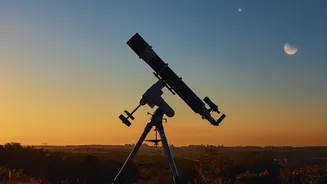
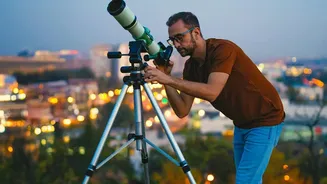
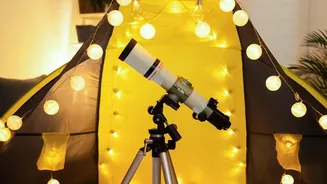
Forget what you think you know about needing a powerful telescope. For your first time, the best tools are your own two eyes. The goal is to familiarise yourself with the sky, and that's best done with a wide, natural view. A pair of standard binoculars can be a great next step, offering a closer look at star clusters or the moon's craters without the complexity of a telescope. Your real essentials are about comfort: a reclining chair or a thick blanket to lie on, warm layers of clothing as autumn nights can get chilly, and perhaps a flask of a hot beverage to make the experience more enjoyable.
Let Your Eyes Adjust
Once you've found your spot, give your eyes time to adapt to the darkness. It takes about 20 to 30 minutes for your pupils to fully dilate and for you to achieve your best night vision. During this time, avoid looking at any bright screens, especially your phone. The white light will instantly ruin your dark adaptation. If you need to see, use a red light. Red-light torches are ideal, but you can also cover a regular torch with red cellophane or switch your phone screen to a red-light mode. Red light has a minimal effect on your night vision, allowing you to consult a chart or find your flask without plunging your eyes back into daylight mode.
What to Look For in the October Sky
October's evening sky is filled with prominent and easy-to-find constellations for beginners in the Northern Hemisphere. Look for the Great Square of Pegasus, a massive diamond of four bright stars that serves as a great starting point. From there, you can trace other constellations. Another easy-to-spot pattern is Cassiopeia, which looks like a bright 'W' in the sky. Use the right side of the 'W' as an arrow pointing downwards, and with binoculars in a dark sky, you might spot a faint, fuzzy patch of light. That's the Andromeda Galaxy, the most distant object you can see with your unaided eye. Don't forget to look out for planets, which shine with a steady, untwinkling light. Depending on the year, planets like Jupiter or Saturn are often brilliantly visible.
Use an App as Your Guide
A stargazing app on your smartphone is like having a planetarium in your pocket. Apps like Star Walk 2, SkyView Lite, or Stellarium use your phone's GPS and compass to create a real-time map of the sky. Simply point your phone upwards, and the app will identify the stars, constellations, and planets you're looking at. Many have features that overlay the mythological figures onto the star patterns, making them easier to remember. Just remember to switch the app to its red-light 'night mode' to protect your dark-adapted eyes. These tools are fantastic for beginners, removing the guesswork and letting you quickly learn the layout of your night sky.