


More Than Just Empty Air
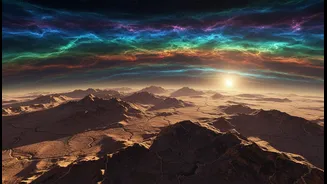
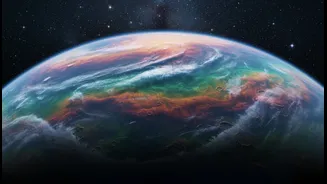
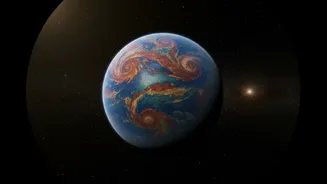
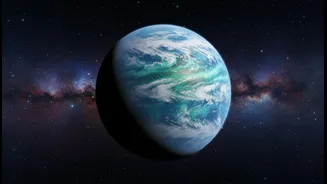
An atmosphere is more than just a layer of gas; it's a planet's fingerprint. For decades, scientists have theorized that the key to finding life beyond Earth lies in deciphering these atmospheric clues. An atmosphere regulates a planet's temperature,
shields it from harmful radiation, and can host the chemical ingredients necessary for life. Without our own, Earth's surface would be a frozen, uninhabitable rock. Simply being in a star's "habitable zone"—the orbital sweet spot where liquid water could exist—isn't enough. As the comparison between Earth and Venus shows, two planets of similar size can have wildly different fates based on their atmospheric composition. One supports life, while the other is a scorching hothouse. This is why studying the air of distant worlds is so critical; it’s the bridge between a planet being merely habitable in theory and potentially inhabited in reality.
A Breakthrough in the Clouds
The latest buzz in the astronomy world revolves around a rocky planet named LHS 1140b, located about 48 light-years away. In a landmark discovery announced in mid-July 2026, scientists confirmed for the first time that this Earth-like planet, which sits squarely in its star's habitable zone, has an atmosphere. This is a monumental step forward because most rocky planets found orbiting the common but volatile M-class dwarf stars are thought to have their atmospheres stripped away early in their lives. The detection of an atmosphere on LHS 1140b suggests that some rocky worlds can hold onto their gaseous envelopes, dramatically increasing the chances that such planets could be habitable. This finding moves the goalposts from merely wondering if these planets can have atmospheres to now being able to actually study one.
Our New Eyes on the Sky
These breakthroughs are being driven by a new generation of powerful observatories, most notably the James Webb Space Telescope (JWST). Its incredible sensitivity allows astronomers to use a technique called transmission spectroscopy. When an exoplanet passes in front of its star, the starlight filters through the planet's atmosphere. By analyzing the spectrum of this light, scientists can identify the chemical elements and molecules present. In another recent example, astronomers using JWST discovered a third giant planet, Beta Pictoris d, not by seeing it directly, but by detecting the unique chemical fingerprint of its atmosphere. This technique is transforming the search, allowing for the discovery of worlds hidden in the glare of their stars and providing a detailed breakdown of their atmospheric content.
The Search for Biosignatures
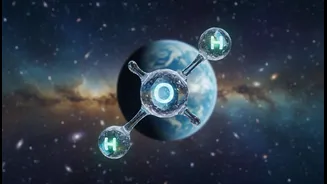
Detecting an atmosphere is the first step; the next is to look for 'biosignatures'—gases or combinations of gases that strongly indicate the presence of life. On Earth, the coexistence of oxygen and methane is a huge telltale sign; these gases would normally destroy each other, so their sustained presence suggests they are constantly being replenished, likely by biological processes. Scientists are now looking for similar chemical imbalances on other worlds. Finding a single gas like carbon dioxide isn't enough, as it can be produced by volcanoes. Instead, the goal is to find specific combinations, like methane and carbon dioxide without an abundance of carbon monoxide, that would be hard to explain without biology. With JWST, we are getting closer to being able to detect these subtle but crucial chemical cocktails.