





A Cosmic Crash Site in Our Backyard
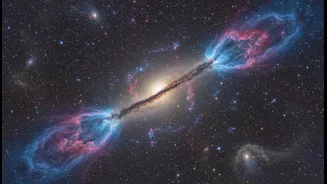
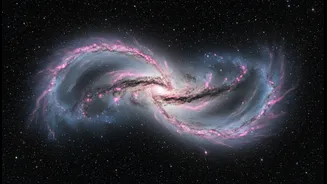
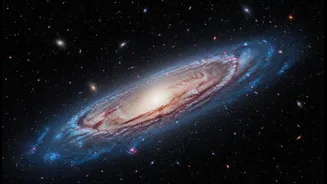
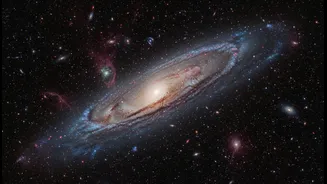
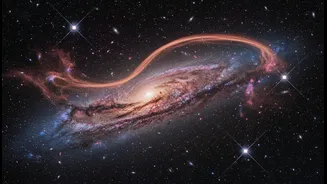
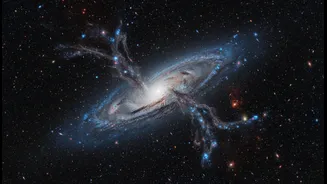
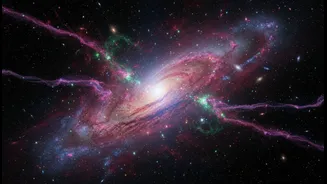
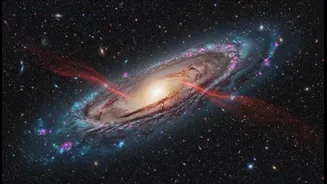
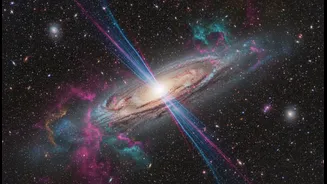
Centaurus A isn't just any galaxy; it's the result of a colossal cosmic collision. Located about 11 to 13 million light-years away, it's one of the closest active galaxies to Earth. Astronomers believe that about two billion years ago, a large elliptical
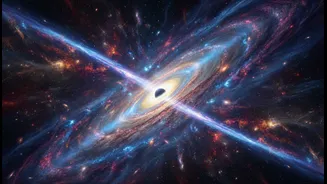
galaxy collided with and absorbed a smaller spiral galaxy. This ancient merger left Centaurus A with its peculiar and beautiful shape: a bright, elongated glow of older stars cut through by a thick, dark band of dust. This dust lane is the mangled remnant of the spiral galaxy, now a hotbed of intense star formation. At its heart lies a supermassive black hole, 55 million times the mass of our Sun, which is actively feeding on the surrounding gas and dust, making the galaxy's core incredibly energetic.
Why Webb's View Is a Game-Changer
For years, that thick band of dust has acted like a curtain, hiding the galaxy's core from telescopes like Hubble, which primarily see in visible light. Other infrared telescopes, like the now-retired Spitzer, could peer into the dust but lacked the power to resolve fine details. This is where the James Webb Space Telescope (JWST) changes everything. Its powerful near- and mid-infrared instruments, NIRCam and MIRI, can cut through the obscuring dust with unprecedented clarity. The result is that what once appeared as a hazy, grainy glow is now revealed to be a densely packed field of millions of individual stars. It's like switching from an old television to a 4K display; the level of detail is simply astonishing.
Galactic Archaeology: Reading History in the Stars
Being able to see individual stars is more than just a pretty picture; it turns astronomy into a form of archaeology. Scientists can now study the different generations of stars within Centaurus A to piece together its violent history. They can identify which stars are ancient, existing before the merger, which ones were formed during the chaotic collision, and which are newborns created from the gas and dust stirred up in the aftermath. Each star acts as a fossil record, helping to build a detailed timeline of the galaxy's evolution. This allows astronomers to study the effects of a galactic merger in a way that has never been possible before, providing crucial insights into how galaxies grow and change over billions of years.
New Mysteries in the Dust
While Webb’s images answer many questions, they also reveal new puzzles. The mid-infrared view highlights intricate filaments and glowing clouds of warm dust that have surprised astronomers. One of the most perplexing new details is a faint, 'S'-shaped structure curving near the galaxy's center. Scientists are not yet sure what created this feature. It could be a scar left over from the ancient merger, or it might be shaped by the powerful jets of energy blasting out from the supermassive black hole. This black hole has a complex relationship with its galaxy; its energy output can compress gas to trigger star birth in some areas while blowing material away and halting it in others. Understanding these newly seen structures is the next major task for researchers.