


The Race to the Beginning of Time
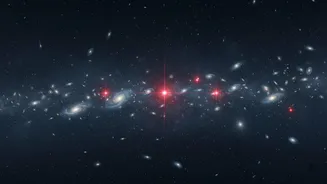
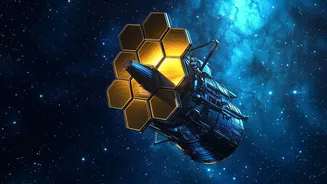
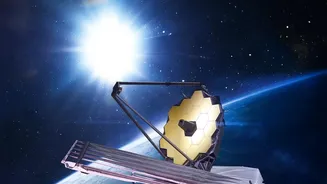
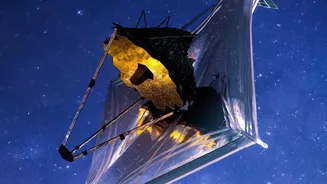
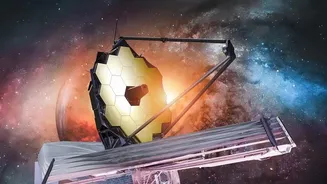
Since it began operations, the James Webb Space Telescope has been locked in a race to find the earliest, most distant galaxies. Almost immediately, scientists began finding dozens of promising candidates—faint, reddish specks of light that appeared to be from
the first few hundred million years after the Big Bang. One candidate, known as CEERS-93316, caused a huge stir. Initial analysis suggested it was at a staggering redshift of 16.4, meaning we were seeing it as it was just 250 million years after the universe began. If true, it would have shattered the record. This is the thrilling frontier of modern astronomy, where every new image could potentially rewrite our understanding of the cosmos. But the story of these 'little red dots' is also a brilliant lesson in the scientific process and the difference between a promising clue and hard evidence.
Why Red Means Far in an Expanding Universe
To understand these discoveries, we need to grasp one key concept: redshift. Because the universe has been expanding since the Big Bang, the space between us and a distant galaxy is constantly stretching. As light travels across this expanding space, its waves are also stretched. Think of an ambulance siren changing pitch as it moves away from you. For light, this stretching shifts its color toward the red end of the spectrum. The farther away a galaxy is, the more its light has been stretched, and the 'redder' it appears to us. JWST is a master at detecting this faint, ancient, redshifted light, which is invisible to the human eye. So when astronomers find an object that is exceptionally red, it’s a tantalizing sign that they might be looking at something from the dawn of time.
The Guess vs. The Gold Standard
Finding these red dots, however, is only the first step. The initial method for estimating their distance is called photometric redshift. Essentially, astronomers measure a galaxy’s brightness through a handful of different colored filters. By seeing which filters the galaxy is brightest or dimmest in, they can make an educated guess about its redshift. It’s fast and efficient for sorting through thousands of objects. But it’s still a guess. The gold standard for confirmation is spectroscopy. This is a much more detailed process where the telescope’s instruments split the galaxy's light into a full spectrum, like a rainbow. Within this spectrum, astronomers can see the unique chemical fingerprints of elements like hydrogen and oxygen. By measuring exactly how much these fingerprints have been shifted to the red, they can determine a precise, unambiguous redshift.
The Case of the Great Impostor
When astronomers pointed JWST's spectrograph at CEERS-93316, the supposed record-breaker, they got a surprise. The data revealed it wasn't at a redshift of 16.4 at all. Its true, spectroscopically-confirmed redshift was a much more modest 4.9. This means we see it as it was about 1.2 billion years after the Big Bang—still incredibly ancient, but not from the universe’s infancy. So what happened? It turned out that extremely hot gas within this 'impostor' galaxy was emitting a huge amount of light in very specific colors. By a stroke of bad luck, these emissions perfectly mimicked the signature of a much more distant object when viewed only through the broad color filters of photometry. It was a classic case of mistaken identity, and a perfect example of why spectroscopic proof is non-negotiable.
How to Be a Smarter Space Reader
This story isn’t about failure; it’s about science working exactly as it should. For space enthusiasts, it offers a guide to reading the news. First, look for the magic words: 'spectroscopically confirmed'. If an article mentions a 'candidate' galaxy or a 'photometric redshift', treat it as an exciting but preliminary finding that awaits confirmation. Sometimes, like with another object called Maisie's Galaxy, spectroscopy proves the initial guess was very close. But often, as with CEERS-93316, the story changes. Embracing this process—the hypothesis, the test, and the revision—is key. The constant refinement of our knowledge is where the real adventure of discovery lies, reminding us that extraordinary claims always require extraordinary evidence.