


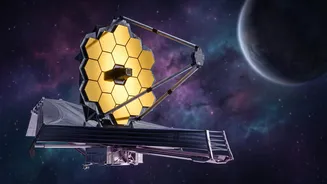
A Landmark Discovery
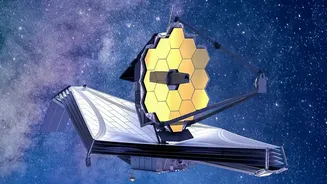
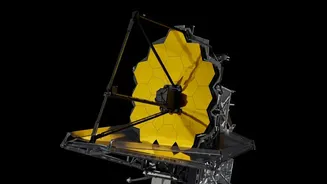
In a series of groundbreaking observations, astronomers have used the James Webb Space Telescope to confirm the presence of water vapour in the atmospheres of several exoplanets—planets orbiting stars outside our solar system. One of the most recent and
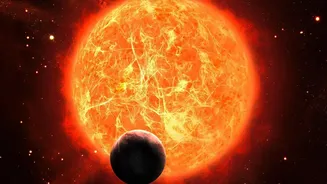
significant findings involves WASP-39b, a gas giant located nearly 700 light-years from Earth. Using Webb’s powerful instruments, an international team of scientists detected not just water, but a specific type known as semi-heavy water (HDO). This discovery, published on a preprint server and currently undergoing peer review, marks the first time this variant of water has been confidently identified on a world beyond our own solar system. While WASP-39b is a hot, uninhabitable gas giant, the ability to detect such a specific molecule is a monumental achievement. It proves the telescope's capability to analyse atmospheric compositions with unprecedented detail, a technique that will be crucial when studying smaller, rocky worlds that might harbour life.
How Webb 'Sees' the Unseeable
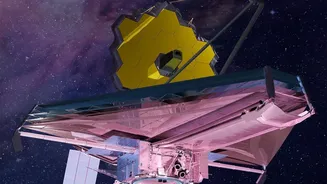
So, how does a telescope 1.5 million kilometres away detect water on a planet hundreds of light-years distant? The magic lies in its powerful infrared sensors and a technique called transmission spectroscopy. When an exoplanet passes in front of its host star from our perspective—an event called a transit—the star's light filters through the planet's atmosphere. Different gases in the atmosphere absorb specific wavelengths, or colours, of light. This creates a unique chemical 'fingerprint' in the light spectrum that reaches the telescope. Webb's instruments, like the Near-Infrared Spectrograph (NIRSpec) and Mid-Infrared Instrument (MIRI), are exquisitely sensitive to these infrared wavelengths. By capturing and analysing this filtered starlight, scientists can identify the molecules present, including the unmistakable signature of water vapour. This method has been used not only on gas giants but also to find hints of water on rocky planets like GJ 486 b and in the planet-forming disks of young stars.
More Than Just Water
The detection of semi-heavy water on WASP-39b is particularly exciting because it provides clues about the planet's history. Semi-heavy water contains a heavier isotope of hydrogen called deuterium. The ratio of deuterium to regular hydrogen can tell scientists where in its star system the planet originally formed and how it migrated over billions of years. For instance, the ratio found on WASP-39b is much higher than that of Earth's oceans, suggesting a different formation story. This type of detailed analysis moves exoplanet science from simply finding other worlds to truly understanding them. In other systems, like that of the star TOI-270, Webb's observations of water vapour have sparked debate among scientists about whether a planet could be a 'water world' with a deep, globe-spanning ocean. Though conditions on these planets are often extreme—with boiling temperatures and crushing pressures—each detection of water adds a vital piece to the puzzle.
The Quest for Habitable Worlds
Ultimately, the goal is to find a world much like our own: a small, rocky planet in the 'habitable zone' of its star, where temperatures allow for liquid water on the surface. The discoveries on hot gas giants and scorching rocky worlds are crucial stepping stones. They refine the techniques and build the knowledge base needed for the much harder task of studying Earth-like planets. The JWST is already turning its gaze toward such targets, including the planets in the famous TRAPPIST-1 system. One of these, TRAPPIST-1 e, orbits at a distance where liquid water is theoretically possible. The ability to detect water vapour is the first step; the next will be searching for a combination of gases—like oxygen, methane, and carbon dioxide—that could indicate the presence of biological processes. Finding water is no guarantee of life, but it confirms that one of its most essential ingredients is scattered across the galaxy, waiting to be found.